




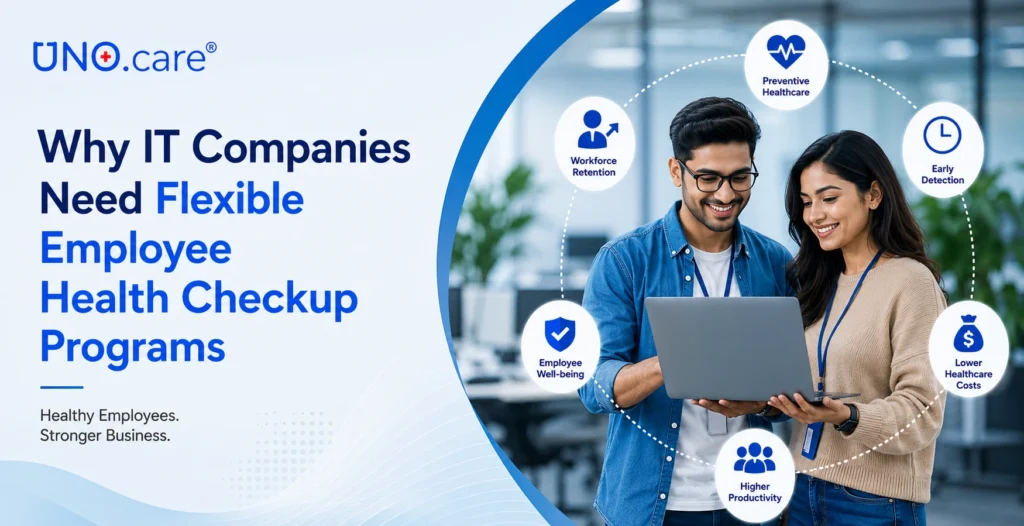
The modern IT worker does not typically work from a single location or time schedule any longer. The usual work location of an IT employee can be a corporate office, customer site, home, or city where the employer’s presence. Some teams operate on business hours, while others provide services to global clients at night or change shifts often.
Traditional one-day health camps do not work effectively for such workers. Employees can miss the event due to remote work, deadlines for project completion, travel, or leave. Even if employees show up, they can only receive a report and may not consult with a doctor.
An alternative flexible employee health checkup program resolves the accessibility issue by providing employees with many days, places, and services available.
Why Conventional Health Checkups Fall Short?
Many companies prefer to conduct their medical checkups in the format of an annual event. The medical team visits the office, employees are screened during the indicated time, and report generation happens later.
This approach can be regarded as effective for companies with people working in one location, while it is not the case for IT companies with several offices around the world.
Main problem areas:
- Remote work employees miss the checkup
- Hybrid work employees do not work from the office on the day of the checkup
- Employees working at night cannot come for screening during the day
- Employees who work with clients have little control over their schedule
- Small branches do not have sufficient staff necessary for making a mobile camp
- Employees lose their slots if meetings take more time than expected
- Reports are given without any additional medical advice
- Follow-up consultations are not controlled
- Data about participation in the program goes from one vendor to another
- Employees are worried about who will access their reports
Low participation does not necessarily mean that employees are not interested in the program. It just means low efficiency of the program for their needs.
Health Priorities Within the IT Workforce
Working in IT might seem to be much safer than working at an industrial facility. However, there are various health issues associated with this type of work.
- Prolonged Sitting
Software engineers and people involved in customer support or project management often have to spend a lot of time sitting. According to WHO recommendations, adults should minimize sedentary time in favor of regular physical activity. IT companies should set up employee wellness programming that promotes healthy habits and provides checkups.
- Extended Screen Exposure
Individuals might spend many hours using their computers, phones, or having virtual meetings. This is most likely to lead to problems with the eyes, such as discomfort and fatigue, as well as difficulty in maintaining the work-rest balance.
Proper health programs will help employees with some help concerning vision, awareness of ergonomics, and access to specialists.
- Musculoskeletal Discomfort
Poorly designed workplaces, unergonomic workstations, and insufficient movement might lead to discomfort in the neck, back, shoulders, and wrists.
Programs that monitor the health of employees will help determine those who need evaluation.
- Irregular Schedules
International teams often work night shifts. The fact that employees have irregular schedules influences their sleep patterns and access to healthy food. Workplace health programs must offer appointments beyond regular working hours whenever possible.
- Load and Stress
The pressures of deadlines, client expectations, on-call duties, and lack of control can put a lot of stress on employees.
An employee health analysis can’t fix the unhealthy working conditions, but it can be part of a larger initiative that includes workload management, management training, and assistance with mental well-being in a confidential manner.
What Makes an Employee Health Checkup Program Flexible?
Flexibility involves making it possible for employees to choose practical options that will not infringe upon clinical integrity or data safety. A flexible program can include things like:
- Multiple checkup dates
- Appointments at multiple offices
- Access to a national diagnostic network
- At-home sample collection when appropriate
- Early and late appointments
- Meetings at certain times on different shifts
- Online appointment reservation and changes
- Teleconsultation after receiving results
- Various checkup panels depending on age and risk factors
- Optional family health programs
- Sending digital reports to patients
- Delivery of information and services in different languages
Being flexible does not mean providing all services remotely because certain tests, evaluations, and medical procedures require hospital care or qualified personnel.
Matching Checkups to Different Work Arrangements
| Work arrangement | Suitable program format |
| Office-based employees | On-site checkup days with staggered appointment slots |
| Hybrid employees | Multiple office dates plus access to nearby diagnostic centres |
| Remote employees | Network centres or home collection where clinically appropriate |
| Night-shift teams | Early-morning, evening or shift-aligned appointments |
| Employees at client sites | Portable benefits through an approved provider network |
| Employees in smaller cities | Regional diagnostic partners and teleconsultation support |
This blended model helps corporate health checkups for IT companies reach more employees without forcing every employee into the same process.
How Flexible Health Checkups Support IT Companies?
- Enhance Employee Accessibility
A traditional health camp requires employees to modify both their work schedule and location based on the implementation of the program. A flexible health program allows the service to be implemented depending on the availability of the employees.
The employees have the liberty of selecting whenever and wherever they want to participate.
- Minimize Disruption During Working Hours
The employees may refrain from using health camps because they expect long waiting times or being away from work for hours.
Electronic booking, specific timeframes, and availability of many service locations may help cut waiting altogether. Employees can schedule their participation as a matter of priority without disturbing business processes.
- Provide Equal Access for Remote and Hybrid Workers
The health benefits provided by IT companies should not be accessible only to those who can regularly work at a major office.
A decentralized system will enable remote workers and those based in branch offices to qualify for the same core health services through approved diagnostic partners.
The way of providing the services may vary, but eligibility criteria and clinical standards will remain the same.
- Provide More Customized Screening
A software developer aged 25 and a senior manager aged 50 have different needs when it comes to preventive screening tests.
The assessments should be performed by skilled medical experts and based on criteria like:
- Age
- Gender
- Health condition
- Family background
- Risk factors
- Work timetable
- Work responsibilities
- Past results
- Clinical guidance
Preventive health screenings should differ from one person to another, which means that the same health-check package should not be administered to all employees. Unnecessary assessments can provoke worries or generate muddled results and extra expenses without any irrefutable clinical significance.
- Provide Follow-Up Healthcare
The checkup should not end with the report. Employees will need:
- Doctor consultation
- Results interpretation
- Re-testing
- Referring to a specialist
- Lifestyle advice
- Constant observation
- Contribution through healthcare benefits system
Flexible programs may suggest teleconference and visit options and help employees understand what next steps should be performed.
The number of individuals who checked their health demonstrates their participation, while the number of people who completed the follow-up answers the question of how helpful the procedure was.
- Provide Consistent Experience in Different Locations
Technology firms often have their team members working out of different cities, and each of these locations may have a separate vendor and testing panel. A unified approach will enable the standardization of:
- Employee eligibility
- Basic panel of tests
- Workflow of booking appointments
- Quality standards for the providers
- Consultation process with doctors
- Escalation procedure
- Aggregated reporting
- Enhancing the overall wellness strategy
Employee health checkup programs are more effective when linked with comprehensive wellness services. Aggregated and anonymized results may be useful for employers to decide on improving the following:
- Ergonomics assessments
- Exercise programs
- Nutrition assistance
- Sleep education
- Mental health support
- Preventive consultations
- Health insurance benefits
- Manager training
Employers should take advantage of collective insights to provide better services to employees, while individual data has to be kept confidential.
Current Compliance Context in India
The Occupational Safety, Health and Working Conditions Code, 2020 came into effect on 21 November 2025.
In accordance with Section 6 of the Code, employers are expected to conduct annual check-ups for their employees of a certain age and type of establishment set by the respective government body.
By May 2026, the Government introduced a country-wide program of check-ups for employees aged 40 and above. The requirements for each particular IT company can differ, considering:
- The number of employees
- The type of establishment
- The age category of the employees
- The regulations established by relevant authorities
- Other notifications.
Thus, it is up to each IT company to check what requirements are relevant for their establishment rather than take it for granted that the same check-up procedure applies to each employee of the establishment. Many organizations might want to offer more extensive checkups as a perk for their employees in addition to minimal required compliance.
What a Complete Checkup Program Should Include?
- Assessment of Employment Force Requirements
Study employee bases, ages, work systems, shifts used, benefits provided, and past applications.
Do not compel staff to reveal any unnecessary medical information concerning program planning.
- Appropriate Testing Panels for Member Patients
The approach to screening must be designed by an expert medical team. The program might consist of a basic panel with optional additional tests based on age or risk.
Screening should facilitate relevant preventive measures and referrals rather than solely increasing the number of tests carried out.
- Booking Options for Users
Employees should be able to choose, move, or cancel reservations with the help of a simple digital process.
Booking assistance should remain available for employees requiring support.
- Network of Approved Providers
The provider network must comply with established standards regarding:
- Staff qualification
- Sample processing
- Equipment quality
- Accreditation where necessary
- Turnaround time of reports
- Data protection
- Clinical escalation process
- Assistance for employees
- Consultation with the doctor
Organizations should allow their employees to consult a qualified physician for an explanation of the report and the next steps.
It should be noted that the automated summaries of reports cannot substitute for consultations with a physician when interpretation is necessary.
- Referrals and follow-up consultations
There should be a system for referrals, repeat testing, and follow-up consultations in the program.
Employers are allowed to monitor the completion of follow-ups in general statistics, but they are not permitted to demand personal diagnoses.
- Employee communication
The communication should clarify the following information:
- Who is eligible
- What is included
- How to book an appointment
- Whether it is voluntary
- Who will get results
- How information will be stored
- What the follow-up support will be
The consequences of refusing to participate in the program.
Protecting Employee Health Information
Health inspection reports are regarded as sensitive data. Therefore, it must be treated with care and caution. In India, the Digital Personal Data Protection Act, 2023 and the Digital Personal Data Protection Rules, 2025 lay down the obligations for safe use of digital personal information.
Taken into consideration, a health inspection program must contain:
- Identification of goals for gathering data
- Collection of only the necessary information
- Appropriate notifications or consent from the employees
- Secure delivery of the inspection report
- Access controlled by authority level
- Encryption and security of the data
- Retention time period must be established
- Data correction and access procedures must be set
- Data destruction procedure must be developed
- Requirements for data protection must be imposed on contractors
- Incident and breach action plan must be developed
- No individual health reports should be provided to any manager
Employers need aggregate health inspection data like general information about participation in the program, usage of its services, and trends in health condition rather than the results of medical exams.
How to Build Flexible Corporate Health Checkup Programs?
- Identify the Workforce
Find out where employees are located, how frequently they use company offices, and which work groups are using flexible schedules.
- Establish Goals of the Program
Determine whether the program will meet a particular standard or objective, help employees gain access to preventive services, provide help to older employees, or enhance the overall wellness plan.
- Choose Delivery Methods
Decide whether to have on-site camps, diagnostics centres, home collection of samples, and telemedicine,e or a combination of them based on the requirements of the workforce and the clinical appropriateness.
- Design the Methodology of Screenings
Work with qualified healthcare professionals to develop the main types of checkups: conventional, age group-oriented, and risk-oriented.
- Define the Limits of Confidentiality
Examine which materials the employer has access to and which information is limited to employees and healthcare providers.
- Conduct a Trial
Establish the real efficiency of the program by testing it with employees from all types of work arrangements: office workers, remote, hybrid, and shift workers.
- Assess and Enhance
Look into participation, experience of scheduling, speed of report generation, and results according to employees’ feedback.
Metrics That Matter
IT corporations can watch:
- Qualified workers
- Workers who made appointments
- Checkup completion percentage
- Completion percentage according to work arrangement
- Appointment cancellation and no-show percentage
- Average time taken to receive the report
- Completion of doctor consultations
- Completion of referrals and follow-ups
- Workers’ satisfaction level
- Complaints from providers
- Amount of time that workers spent away from the office
- Participation across multiple cities and offices
Data breaches or incidents when data was accessed. All reports should be done in aggregation mode.
Common Mistakes to Avoid
- Limiting the Availability of Checkups
Having one single day option excludes people who are working from home, on the road, off on holiday, or have an important project to oversee.
- Using the Better Panel for Everybody
The approach to getting screened for medical issues should depend on age, health history, and clinical risk.
- Making Employees Feel Compelled to Take Part
Employees should know whether doing the screening is a legally required procedure or a voluntary benefit.
- Giving the Reports to the Managers
Managers should not get private medical information of their workers or any clinical findings.
- Closing Down the Program after Reports Have Been Given
When a report shows an issue in need of action, employees need consulting and referral help.
- Just Calculating the Participation Rate
A lot of screenings do not mean that employees have understood their results and followed the recommendations.
- Choosing Providers Based on Price Only
Provider quality, coverage, turnaround time, customer service, data protection, and clinical management should be taken into account.
Make Preventive Care Fit the Way IT Employees Work
Contemporary workers in IT work from various locations, are mobile, and have different schedules. The healthcare programs developed for employees should reflect these facts. An efficient health check-up program allows employees to access preventive care in various locations at different times.
A successful program should provide a comfortable booking process, allow employees to choose between various service options, ensure the right medical check-up is made, maintain strong doctor-patient confidentiality, and guarantee that follow-up checks are done.
One more important point is that healthcare programs are part of an employee wellness program and should not be treated as stand-alone services done once a year.
The goal is not to perform as many tests as possible, but to help more employees access necessary preventive health check-up services.