








The health check-up program was carried out by your company. It’s ticked in the tracker as done.
And the vast majority of your budget could have been wasted.
It’s a bitter pill to swallow and something very few procurement presentations ever talk about: completing a checkup doesn’t necessarily mean getting a completed checkup. What happens in between can result in the loss of more than 40% of your budget. These are missed appointments, abnormal results never followed through, delayed reporting and an ocean of health data that dies in unreadable PDF files.
Workplace health screening failures happen quietly. No crashes, no alarms. You pay the invoice, file the certificate and move on believing that your team is checked up for the year. And a year later a 34-year old colleague collapses on the floor because of unreported high blood pressure which would be spotted a year ago with an adequately conducted health checkup.
This article will reveal the true cost of inefficiency in the health checkup program: where does the budget go, why isn’t it visible, who pays for it and how to develop a program that works. If you approve budgets for health check-ups, this article will be valuable for you.
What “poor execution” actually means
Inadequate delivery of the health check-up program is the difference between an exercise that is carried out and one that works. Poor delivery of the exercise manifests in the form of low attendance, misrepresentation and delay in reporting, unresponsive abnormal results, and unused information. The check-up takes place on paper – but not the diagnosis, treatment, or prevention of the problems identified.
That is precisely the challenge. Success is measured by whether the camp was run; not whether people were made healthier. And there lies the difference and the money. These are among the most common employee health checkup implementation issues faced by organizations.
Why a completed health checkup can still be worthless
Imagine the size of the risk that needs to be screened for. As per the Indian Council of Medical Research – India survey (Lancet Diabetes & Endocrinology, 2023), an estimated number of 101 million Indians suffer from diabetes, 136 million have pre-diabetes, and 315 million Indians have hypertension. Approximately two-thirds of total deaths in India have been linked to non-communicable diseases by the World Health Organization.
These issues often go unnoticed for years at a stretch. These are silent disorders that do not come to notice until the time becomes a life-threatening emergency situation.
Now, consider the trap you are setting up for yourself. If your organization is reflective of the nation as a whole, then a considerable number of your employees are already harboring a high-risk condition. Any screening procedure that does not actually screen out this issue will be no more than a waste of time and money. Not only will this fail to reduce the risk but it will increase your expenditure on top of that. The worst of both worlds!
Here lies the problem with most employee health checkup programs and the growing employee health checkup program challenges faced by HR, EHS, and procurement teams.
The 7 hidden costs of poor health checkup execution
Here’s where the money actually leaks. Most workplace health screening failures trace to one or more of these.
1. The participation gap
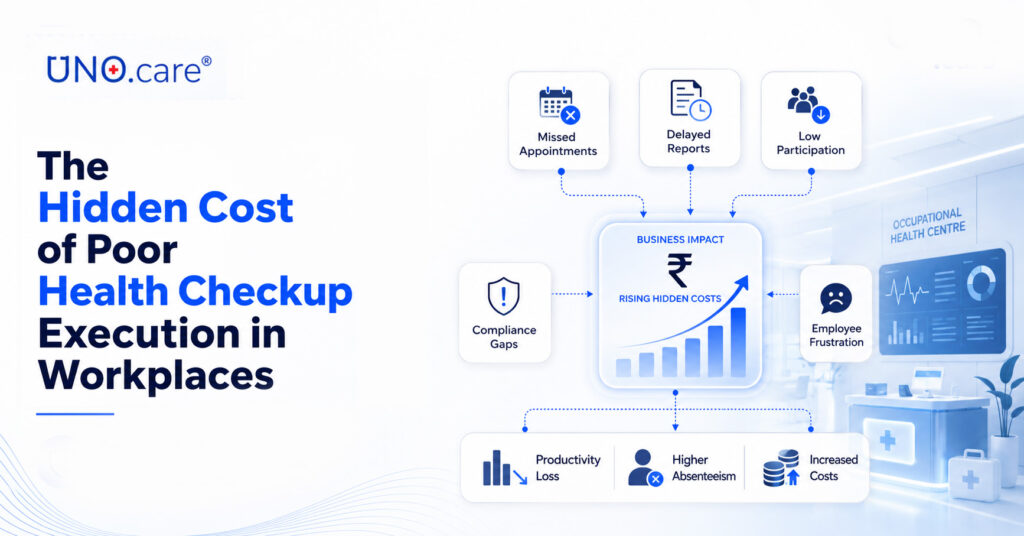
The screening of 55% of the headcount doesn’t screen your entire workforce – half of it gets screened but not always the riskiest one since the latter usually avoid the camp. You have paid per head for complete coverage and got incomplete coverage of wrong persons.
2. Inaccurate or fabricated reports
Under time pressure some providers may automatically fill or forge results. The clean report arrives, everybody feels relaxed, but the disease develops without detection. This is the worst mistake made in medical testing since everything looks okay.
3. The open loop — no follow-up
This is the largest expense within this category. The checkup identifies the problem, the report in PDF format is sent to the employee and nothing happens after that. There is no referral, counselling and re-testing. The detection without intervention means zero health benefit. You have just paid for the diagnosis and missed the cure.
4. Delayed reports
Long delivery time hinders hiring of the personnel, frustrates hiring managers and decreases their trust in the whole process. If the report arrives in three weeks, it is too late. Delays like these significantly increase occupational health checkup costs for employers by affecting productivity and workforce planning.
5. Data that dies in PDFs
Without aggregate analysis, the leadership is not able to identify the areas of risks, to focus interventions, and to justify the ROI to finance. The single most important product of screening — population health intelligence — is being wasted. It is among the costliest corporate wellness program inefficiencies.
6. Compliance exposure
Incomplete or irretrievable documents lead to an audit finding under Factories Act and OSHWC Code, 2020, even though the screenings have been carried out. “We’ve implemented the program” does not work as a defence if you are not able to retrieve the document at a particular site, instantly.
7. Eroding employee trust
Lines of people, repeat visits, no results explanation – a bad experience makes employees believe that the program is not worth the effort. Participation rate becomes even lower the next year around, further compounding employee health checkup program challenges.
The compounding effect: how small leaks become a flood
These costs are not independent of each other. They compound.
Low participation drives the data gap. The data gap conceals the undiagnosed risks. Undiagnosed risks lead to undiagnosed conditions. These become chronic diseases that lead to absenteeism, presenteeism, increased medical insurance claims, and attrition of skilled individuals at the most inopportune times. Absenteeism is widely understood to be less costly than presenteeism in occupational health studies due to its invisibility.
And yet the cost falls on those who never sign the checkup contract: the CFO whose medical premiums are increasing, the line manager who must cover for his or her ill team, the EHS executive who must explain an avoidable accident, and the individual worker who finds out he or she has a serious illness from a hospital doctor rather than the screening. These hidden impacts are among the biggest occupational health checkup costs organizations fail to account for.
Thus, the question is not “did we conduct the checkup?” The question is “has the health checkup made a difference?” And in most cases where the programs have been poorly implemented, the answer is no.
Paper checkup vs a checkup that works
| Dimension | Poorly executed | Well executed |
| Participation | 50–60%, self-selected | 90%+, actively driven |
| Report accuracy | Rushed, sometimes fabricated | NABL/NABH-verified |
| Turnaround | Weeks | ~48 hours |
| Follow-up | Open loop, no action | Closed loop, referral + re-test |
| Data | Siloed PDFs | Aggregated dashboard |
| Compliance | Scrambles at audit | Continuously audit-ready |
| Outcome | Spend, no change | Early detection, lower risk |
How to fix execution
It’s not about throwing more money at the problem. It’s about plugging the leaks.
- Drive participation consciously – camps, collections at the office for corporate employees, reminders, and visible leadership for those pending.
- Demand accredited labs – NABL/NABH per center, so results are reliable and defensible.
- Close the loop – every abnormal result must drive a follow-up of referral, counseling or re-testing. Period.
- Speed up turnaround – demand TAT of reports from vendors and benchmark how many comply.
- Convert data into intelligence – dashboard showing risk aggregate and not individual PDFs.
- Centralize responsibility – one partner is better than four vendors blaming each other. Plus cheaper, normally.
These measures directly address employee health checkup implementation issues, reduce corporate wellness program inefficiencies, and improve long-term outcomes from every Health Checkup.
The guiding philosophy behind all of this: Measure the program by outcomes and not execution of camp.
How UNO.care Closes the Execution Gap
UNO.care was conceived and designed with the failure mentioned in the article in mind – the disconnect between screening and its success.
The model works in a closed-loop fashion. Screening and diagnosis work hand in hand using 1,200+ NABL/NABH laboratory partners, and any abnormalities found are referred to further teleconsultations and follow-up care rather than ending up in some PDF document. Report processing is completed in 48 hours so that pre-employment joinings never get stuck due to delay. All data goes into the live dashboard providing HR and EHS managers with overall risk profile visibility and audit-ready data for every site based on Factories Act, DISH, Mines Act, and OSHWC guidelines.
Execution reliability was the main idea behind the model: camp presence on-site with 95% guarantee of doctor-nurse presence, pan-India reach covering 18,000+ pincodes to ensure no site is skipped, and full-cycle coordination by a single responsible team. That is why 600+ companies and more than 500+ sites, such as Eicher, Volvo, Hindalco, L&T, and Cipla, have stayed within the framework, having 97% of them repeating their cycle.
By eliminating workplace health screening failures, reducing employee health checkup program challenges, and minimizing occupational health checkup costs, UNO.care ensures every Health Checkup delivers measurable business and health outcomes.
The value isn’t in running a camp. It’s in making sure the camp actually detects, reports, and acts — which is exactly where poorly executed programs leak their money.
The most costly Health Checkup program is not necessarily the one with the highest cost per head. Rather, it is the program that is done, ticked off the list, and accomplishes nothing since you have paid for it but haven’t changed the underlying risk at all.
Incompetent delivery becomes obvious only after the fact – when claims start mounting up, a valuable employee succumbs to exhaustion or a preventable condition is detected in the hospital rather than in a screening room. Address the problems: the leaks – in participation, in accuracy, in follow-through, in turn-around times, in data management, in compliance and in trust – and the exact same budget will produce exactly what it should have produced all along: early detection, reduced risk, better health, and a deliverable program.
Stop asking whether the checkup has been performed. Start asking whether your Health Checkup program actually works.