







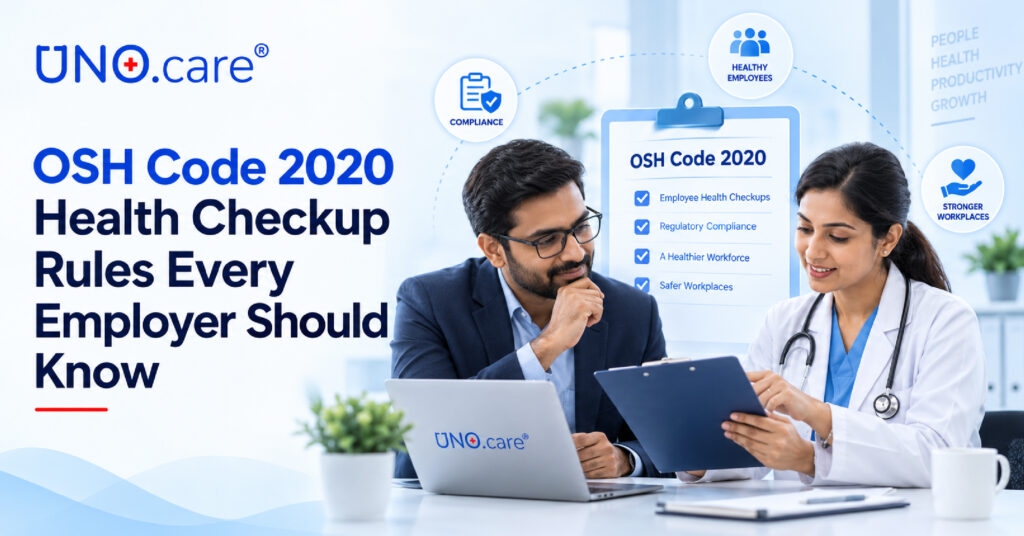
For many HR and EHS teams, employee medical examinations used to sit somewhere between a wellness benefit and a statutory exercise. The Occupational Safety, Health and Working Conditions Code, 2020 changes that conversation. With the four Labour Codes brought into effect from 21 November 2025, workforce health is now more firmly connected with an employer’s compliance responsibilities.
Understanding the OSH Code 2020 health checkup rules is therefore no longer relevant only to factories or high-risk industries. It is necessary for employers to gain knowledge regarding the individuals who require assessment, the liability of expenditures, different occupational hazards to be taken into consideration, and, no less significant, the kind of documentation that has to exist when an audit or check is performed.
What Are the OSH Code 2020 Health Checkup Rules?
Section 6 of the OSH & WC Code places clear health and safety duties on employers. Among them is the obligation to provide an annual health examination or test, free of cost, to employees of such age or class and in such establishments as may be prescribed by the appropriate government. The Code also says employees should not be charged for medical examinations or investigations undertaken for workplace health and safety purposes.
That distinction matters.
The OSH Code 2020 annual health checkup should not automatically be treated as an optional corporate wellness package. Depending on the establishment, workforce and applicable rules, medical examinations can form part of statutory occupational health responsibilities.
As government communications have made clear since its implementation, free yearly health check-ups for workers is an important part of the Labour Code since it stresses worker welfare.
What is important for HR teams to learn from this experience is one simple lesson: health screening for employees now has to be recorded as an item in the compliance calendar along with other block features.
Does Every Employee Need a Mandatory Health Checkup?
This is where employers need to avoid oversimplification.
The Code itself provides for annual examinations based on the age or class of employee, establishment or class of establishment prescribed by the appropriate government. Meanwhile, the government launched a nationwide ESIC annual health-check programme in May 2026 for insured workers aged 40 years and above.
That does not mean every employer can simply adopt “40 years and above” as the only rule that matters.
The specific requirements for employer medical examinations will differ based on Central or State laws, the type of establishment, and the exposure to occupational risk. Industries such as manufacturing, chemicals, mining, or other hazardous fields may require additional types of examinations. The government has particular guidelines for the hazardous industries regarding the pre-employment, periodic, and post-exposure examination process.
So before designing a mandatory employee health checkup programme, HR and EHS leaders should map the applicable legal requirement against actual workplace risk rather than buying one standard package for everybody.
What Should an Employer Health Checkup Programme Cover?
A good programme starts with risk, not with a laboratory rate card.
For a corporate office, the relevant health concerns may include visual strain, ergonomics, metabolic risks and sedentary work. In a plant, workers may face noise, dust, chemicals, heat, vibration or repetitive physical activity. The medical assessment should reflect those differences.
For stronger employee health checkup compliance, employers should generally build their programme around three layers:
- Eligibility and frequency: Identify which employees require annual, periodic, pre-employment or exposure-linked examinations under applicable rules.
- Role-relevant medical tests: Match tests to workplace hazards rather than giving every employee an identical diagnostic panel.
- Documentation and follow-up: Maintain examination status, fitness reports, referrals and relevant occupational health records in an audit-ready system.
This is where occupational health differs from a generic health camp. The objective is not simply to complete blood tests. It is to understand whether workplace exposure and employee health are creating risks that require intervention.
Medical Examination Compliance Is More Than Conducting a Camp
To illustrate a common scenario, next week’s inspection is on the horizon. HR knows that there was an annual camp that occurred nine months ago, but there are records locked in various email threads. Several night shift employees were absent from the camp and the records of the contractors are with a different vendor. There’s no one who can say with certainty who has gone through the screening and who has not yet done so.
Technically, a health camp happened. Operationally, compliance is weak.
Effective occupational health compliance India programmes therefore need traceability. Employers should be able to establish who was eligible, when examinations occurred, whether employees received them without charge, who remains pending and whether medically significant findings required follow-up.
The OSHWC Code medical examination framework should consequently be viewed as an ongoing process rather than a once-a-year event.
For multi-location organisations, that difference becomes even more important. One missed plant, shift or employee category can create a gap in an otherwise well-run programme.
How HR Teams Can Improve Employee Health Checkup Compliance
Start by creating one workforce-health matrix that brings together employee category, age, work location, job exposure, required examination and due date.
Next, connect HR, EHS and the occupational health team. Compliance becomes messy when HR owns employee data, EHS owns exposure information and a medical vendor simply receives a spreadsheet two days before the camp.
Finally, digitise the trail. A reliable OSH Code annual health checkup programme should make participation status, reports and follow-ups easy to retrieve without chasing multiple clinics.
This approach is particularly valuable for businesses operating across states because occupational health compliance India requirements can involve both the central framework and rules applicable to the establishment concerned.
How UNO.care Simplifies Occupational Health Compliance
Running the programme becomes more difficult as employee numbers, locations and shifts increase.
UNO.care brings employee health checkups, occupational assessments and compliance tracking into one managed system. Its health-checkup programmes cover pre-employment, periodic, occupational and annual examinations, while digital records help HR monitor completion and reduce manual coordination.
For industrial employers, UNO.care also provides OHC staffing & management, including qualified doctors, nurses and paramedics, along with digital consultation and compliance records.
That makes the model useful beyond simply arranging a health checkup. The real value is connecting execution, employee coverage, documentation and follow-up so HR and EHS teams have one view of workforce health.
Make OSH Compliance a System, Not an Annual Reminder
The biggest shift behind the OSH Code health checkup rules is not the addition of another medical camp to HR’s calendar. It is the move toward preventive, documented and employer-led workforce health management.
Employers that treat examinations as a last-minute compliance activity will continue dealing with missed employees, fragmented records and audit pressure. Those that create a structured employee health checkup compliance process can turn the same requirement into better visibility over workforce risks.
If your organisation needs a scalable mandatory employee health checkup, annual screening programme or managed occupational health setup across multiple locations, UNO.care can help you build and execute it end to end.
Talk to UNO.care about creating a compliant employee health checkup programme for your workforce.