







For HR and EHS teams, medical fitness is no longer a box to tick before an audit. India’s four Labour Codes came into force on 21 November 2025, bringing workplace health obligations into sharper focus.
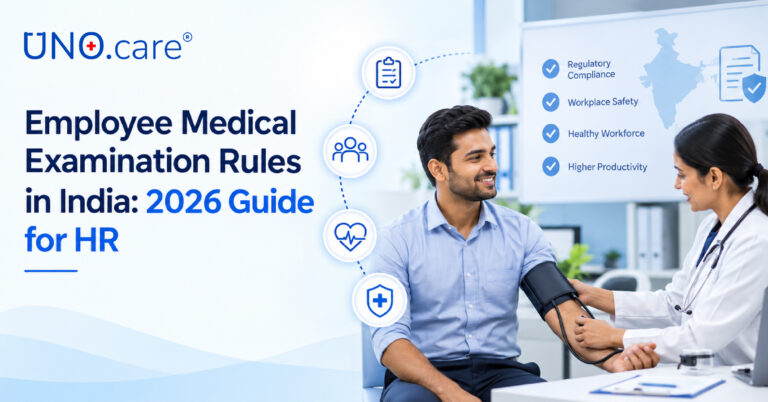
Thus, comprehending employee medical examination rules India becomes an actual 2026 focus, particularly for companies working in factories, storehouses, mining areas, construction sites, and other places with high risk levels. The actual issue is not administering the tests; the issue is knowing who needs to be examined, when, which risks need to be checked, and how to retain the evidence.
Employee Medical Examination Rules India: What Changed?
The legislature on Occupational Safety, Health, and Working Conditions is presently enacted. As per the employer’s handbook from the Ministry of Labour and Employment, the employers are obliged to provide annual check-ups at no cost to the workers as well as to ensure that there are no threats to the workforce that may lead to injuries or illnesses. The Ministry also includes the respective obligation, i.e. the compliance report on the annual check-up for every worker.
The handbook itself notes that it primarily addresses establishments in the Central Government sphere, so HR teams should not treat it as a substitute for checking applicable rules.
Employee medical examination requirements are therefore moving away from a generic “one package for everyone” approach. The Code gives governments rule-making power over the age or class of employees, type of establishment and manner of annual examinations. HR should read the central framework alongside applicable rules, state requirements and sector-specific standards.
In May 2026, ESIC also rolled out free annual health check-ups for insured workers aged 40 and above. It is an important compliance signal, not the only set of employee medical checkup rules India employers need to consider.
When Is a Medical Examination Mandatory for Employees?
There is no sensible compliance answer that begins with “every employee needs the same tests.” A mandatory medical examination for employees depends on the nature of work, occupational exposure and the applicable legal framework.
An office job that comes with little risk is not the same as a role that deals with harmful chemicals, dust, noise, heat, or heavy machines. According to government guidelines, workers in dangerous industries need examinations before starting work, while in-between jobs, and finally at the end of employment.
That is why an occupational medical examination India programme should begin with role and hazard mapping. A paint-shop technician and software engineer should not automatically receive identical screening.
What Do Periodic Medical Examination Requirements Cover?
Periodic medical examination requirements are intended to identify whether workplace exposure is affecting an employee over time. The test panel should therefore follow occupational risk, not a standard wellness brochure.
Depending on the type of role, screening can encompass various evaluations, including clinical evaluation, vision examination, audiometry, pulmonary function tests, blood tests, or other health tests relevant to the job. Specialists in occupational health should contribute in selecting the best tests and determining their frequency.
This is where employee health checkup compliance often breaks down: the camp happens, but coverage, follow-up and fitness outcomes are poorly documented. Conducting tests is only half the job. HR still needs to demonstrate that the correct employees were screened at the appropriate time.
HR’s 2026 Compliance Checklist
For HR teams reviewing employee medical examination rules India, the operational checklist matters more than simply booking a diagnostic vendor.
Map employees by location, role and occupational exposure. Identify applicable central, state and sector requirements. Keep pre-employment, annual and periodic workflows distinct, and define test packages against the role and hazard profile.
Records matter just as much as testing. The Labour Ministry handbook emphasises electronic compliance and record maintenance across the new framework. HR should keep a secure audit trail showing who was due, who completed screening, the examination date, authorised provider and fitness status.
A missed screening, abnormal occupational finding or expired fitness certificate should trigger action rather than sit unnoticed in a spreadsheet.
Annual Checkup, Periodic Exam and Pre-Employment Test Are Different
An employee health checkup may be preventive and broad. A pre-employment assessment looks at fitness for a particular role before joining. Periodic medical examination requirements focus on continued fitness and the possible effects of workplace exposure.
By mixing up these categories, there can be gaps. A generic yearly system still might not include hearing tests or lung function evaluation that are related to an employee’s exposure.
The better approach is to make it risk-based, first deciding the purpose of the examination and only later figuring out what to test. This also allows HR to eliminate unnecessary tests and make compliance programs more defendable.
Why Compliance Becomes an HR Problem
Imagine a company with plants in five states. One location uses a local hospital, another sends workers to a diagnostic centre, and a third collects paper certificates. When an audit arrives, HR discovers different formats, missing reports and no single view of pending examinations.
That is not mainly a healthcare problem. It is a workflow problem.
Employee health checkup compliance improves when test design, scheduling, medical fitness certificates and audit records sit within one operating system. HR should be able to answer a basic question — “Who is compliant today?” — without calling five people or reconciling multiple spreadsheets.
How UNO.care Simplifies Occupational Medical Examination India Programs
UNO.care incorporates corporate health checkups, occupational screenings, diagnostics as well as staffing in a single unified interface. For businesses that administer employee medical checkup rules India on multiple locations, that indicates separated packages according to occupational roles and risks, nation-wide coverage and tangible insight without multiple vendor papers.
UNO.care’s capability encompasses pre-employment, executive and onsite programs, OHC staffing and management. Moreover, it partners with NABL/NABH-accredited laboratory companies for diagnostics, offering digital tracking of finished and pending checkups.
For HR and EHS, the value is fewer follow-ups, faster fitness decisions and cleaner audit evidence. An employee health checkup programme becomes far easier to manage when execution and visibility sit in the same system.
Treat Medical Compliance as a System
The 2026 conversation around employee medical examination rules India is no longer limited to whether a company conducts an annual camp. Employers need a defensible process linking job risk, applicable law, examination frequency, fitness decisions and records.
A mandatory medical examination for employees creates value only when it is relevant to the job and properly tracked. If your organisation manages multiple sites, vendors or occupational-risk categories, UNO.care can help build a centralised, audit-ready programme.
Talk to UNO.care to review your current Employee Health Checkup process and identify where compliance gaps may be hiding.