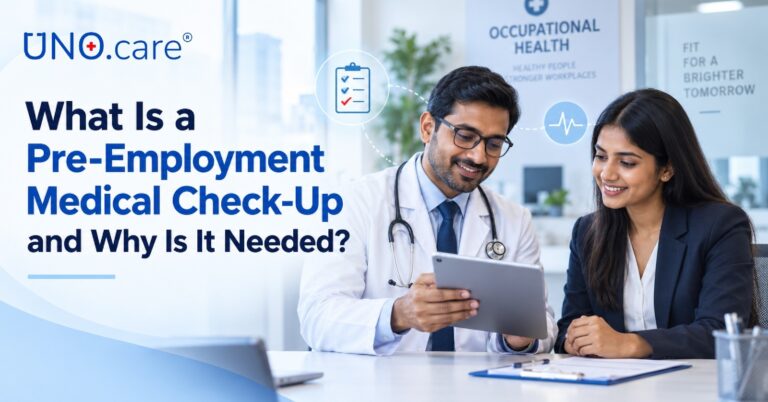








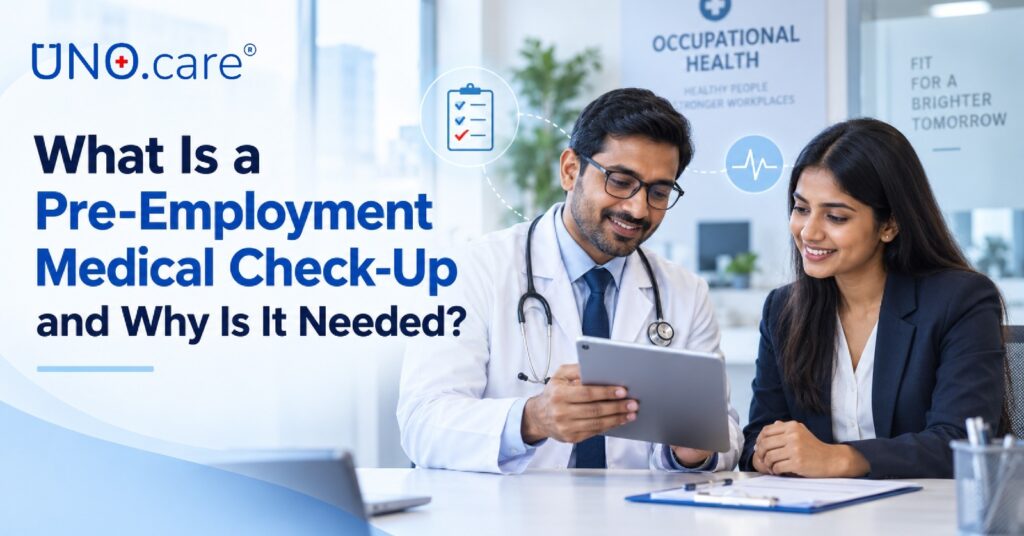
Hiring usually focuses on experience, skills, notice periods and compensation. Yet one question is often addressed only at the end: is the candidate medically fit for the work they are about to take on?
A pre employment medical checkup helps answer that before joining. It is a structured health assessment used to understand whether a candidate can safely perform a particular role while creating a useful baseline for future occupational health monitoring.
What Is a Pre Employment Medical Check Up?
Put simply, a Pre Employment Checkup is a medical assessment carried out before a person begins a new job. The exact tests can differ depending on the employee’s role, working environment, occupational exposure and applicable company or regulatory requirements.
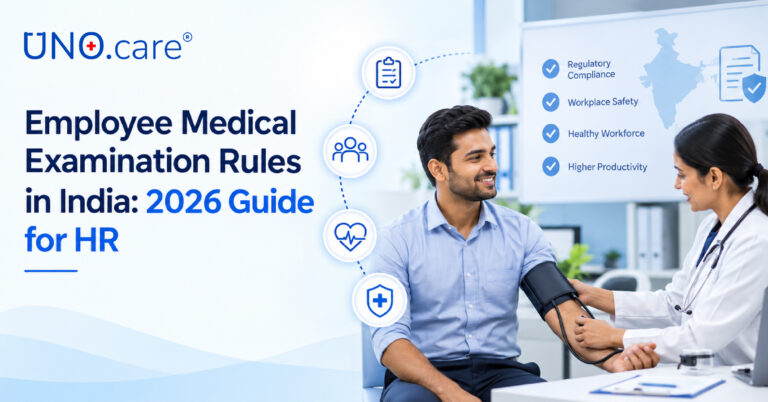
A routine medical evaluation may feature medical records, clinical assessments, vital signs, and initial laboratory tests. Depending on the specific occupation, it may include various tests such as eyesight tests, hearing assessments, pulmonary function tests, and/or electrocardiograms.
Nonetheless, there are stark differences between a clerk operating a computer and a workman about to enter a chemical plant as far as the occupational risk is concerned. Therefore, their medical screening should not be the same.
Why Is a Pre Employment Medical Checkup Needed?
The obvious answer is fitness for the role. But for an employer, the value goes further.
A well-designed pre employment medical checkup can help determine whether a candidate requires further evaluation, work restrictions or appropriate workplace support before deployment. It can also establish a health baseline that becomes useful during future periodic or annual occupational health programmes.
Consider a manufacturing company hiring across several plants. If each location uses a different clinic and test list, HR may receive inconsistent reports, delayed fitness certificates and incomplete records.
That is the difference between conducting tests and running a sound Pre Employment Health Checkup programme.
What Does a Pre-Employment Medical Examination Include?
There cannot be a one-size-fits-all job testing list. Any examinations should be specific to both job responsibilities and job hazards.
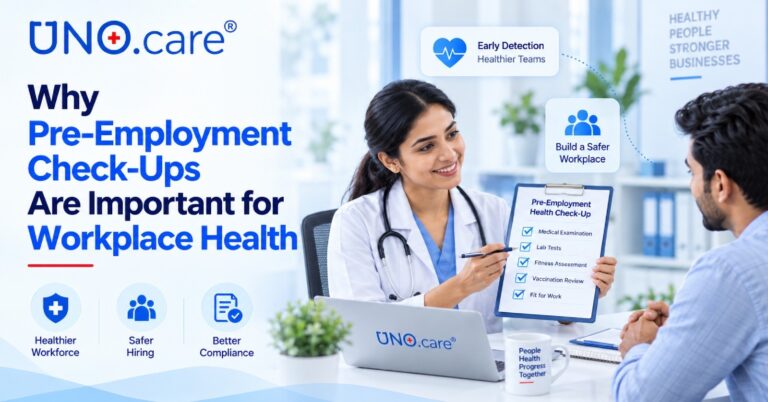
Normally, medical history and physical examination provide the basis. Depending on the requirements of the job, some routine blood or urine tests may be required. Tests of vision and hearing may be directly related to a person’s job activity if a person drives, operates equipment or works in a noisy environment. Furthermore, ECG, lung function tests and other procedures may be included depending on the job requirements.
The better question for HR is not, “How many tests are included?” It is, “Are these the right tests for this employee’s job?”
A bigger package is not automatically a better Pre Employment Checkup. Relevance matters more than volume.
Who Typically Needs a Pre Employment Health Checkup?
Screening can be helpful for many workforces, however, in jobs with physical obligations, safety responsibility, industrial exposure, or special occupational health needs, it is particularly important.
Obvious industries include manufacturing, chemical, pharmaceutical, transportation, mining, energy and construction. Corporates and technology companies may use screening for specific positions or for their overall employee welfare program.
A Pre Employment Medical Examination should connect medical fitness with the actual work being performed.
Where Employers Often Get the Process Wrong
The common mistake is buying a standard package and assuming the job is done.
For companies hiring at scale, operational gaps can be as disruptive as clinical ones. Candidates may be sent to centres that cannot complete every test in one visit. Reports arrive in different formats. HR teams chase candidates, clinics and missing PDFs.
Visibility is another issue. If hiring is happening across several cities, who knows which candidates have completed screening, which reports are pending and which cases need review?
A pre employment medical checkup should reduce onboarding uncertainty, not create another manual workflow.
How UNO.care Simplifies Pre-Employment Medical Checkups
UNO.care approaches screening as an enterprise health programme rather than a series of disconnected diagnostic appointments.
Employers can configure role- and hazard-specific health checkup packages, coordinate screenings across locations and maintain digital fitness documentation through one system. UNO.care also positions its service around NABL/NABH-certified partner facilities, digital reporting and central visibility for HR and EHS teams.
For employers already managing annual health checkups, occupational health centres or broader Employee Health Checkup programmes, pre-employment data can become the starting point of a longer employee health journey rather than a one-time PDF stored in an inbox.
That matters especially for organisations hiring across plants, offices and multiple cities. The challenge is rarely just getting a test done. It is making sure the right test happens, the report reaches the right team and the joining process does not get stuck somewhere in between.
Choosing the Right Pre-Employment Medical Partner
Before selecting a provider, ask four practical questions: Can the package be tailored to the role? Is there dependable coverage wherever hiring takes place? Will reports and fitness certificates follow a consistent digital format? Can HR track completion without repeatedly calling centres?
Those questions often reveal more than a long test list or an impressive network number. The aim should be simple: make screening clinically relevant, operationally predictable and easier to govern.
For an HR or EHS leader, that is ultimately where the value sits. A medical programme should remove uncertainty from hiring, not add another layer of coordination.
Conclusion
A pre employment medical checkup is most valuable when it does more than confirm that a candidate completed a list of tests. It should help an employer understand fitness for work, create a reliable health baseline and move the candidate into the role without unnecessary delays.
If your organisation manages high-volume or multi-location hiring, UNO.care can help standardise the process through role-specific screening, digital records and PAN-India execution. UNO.care currently positions its employee health checkup programme around centralised management, role-specific packages and nationwide execution for enterprise employers.
Talk to the UNO.care team to build a Pre Employment Health Checkup programme around your roles, locations and workforce requirements.