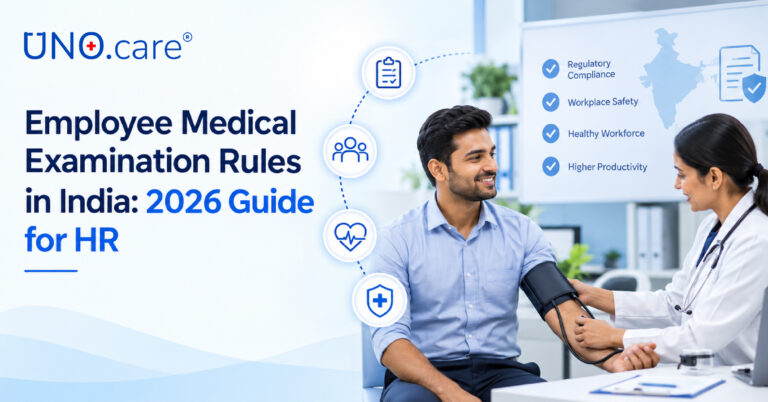

Every year, thousands of Indian companies conduct pre-employment health checkups — yet most HR teams are not entirely sure which tests are legally mandatory versus which are simply company policy. The difference matters significantly when an audit or a court case arrives at your door.
Why Pre-Employment Tests Exist in the First Place
Pre-employment medical examinations serve two distinct purposes. The first is legal compliance — certain Indian statutes require workers in specific industries to undergo medical fitness assessment before starting work. The second is organisational risk management — a company's desire to understand the baseline health of its workforce.
Confusing the two leads to a common problem: companies running expensive wellness packages for all joiners while unknowingly skipping the specific statutory tests that apply to their hazardous process workers.
A general blood panel or chest X-ray, even if expensive and comprehensive, does not satisfy Factories Act obligations unless it specifically includes the tests mandated for the worker's hazardous process.
The Three Laws That Govern Pre-Employment Medical Testing
1. The Factories Act, 1948
Section 41-B requires that workers engaged in any hazardous process — as defined in the First Schedule — must be examined before employment, periodically during employment, and at the time of cessation. Schedule 1 hazardous processes include chemical manufacturing, petroleum refining, fertiliser production, pesticide processing, pharmaceutical manufacturing (certain categories), cement production, and several others.
A pre-employment medical exam under the Factories Act isn't a formality — it creates a medico-legal baseline that protects both the worker and the employer in the event of any future occupational disease claim.
— DISH Guidelines on Occupational Health, 20232. The Mines Act, 1952
All persons employed below ground must undergo a thorough medical examination by a certifying surgeon before being engaged in their first mining employment. The examination must specifically include assessment of respiratory fitness, cardiac function, and vision. Critically, the exam must be conducted by a certifying surgeon designated under the Act — not just any qualified doctor.
3. The Contract Labour Act, 1970
While this Act doesn't mandate specific medical tests, it requires contractors to maintain records of worker health. In practice, DISH and state labour inspectors interpret this as requiring at least a fitness-to-work assessment, especially for manual labour and construction roles.
What the Tests Must Include (By Industry)
| Industry / Role | Governing Law | Minimum Mandatory Tests | Certifying Surgeon? |
|---|---|---|---|
| Chemical / Hazardous Process | Factories Act S.41-B | Physical exam, CBC, LFT, KFT, Chest X-ray, Audiometry, Spirometry | Yes |
| Mines (Underground) | Mines Act 1952 | Physical exam, Chest X-ray, ECG, PFT, Vision, Audiometry, CBC | Yes |
| Pharma (USFDA facilities) | Factories Act + USFDA GMP | Physical exam, CBC, LFT, Skin assessment, Communicable disease screen | Varies |
| Construction / Contract Labour | CLRA Act 1970 | Fitness-to-work certificate, Physical exam, Vision (height-work) | No |
| IT / Office / White-Collar | No specific statute | No legally mandated tests — company policy applies | No |
| Food Processing | FSSAI + State Rules | Communicable disease screen, Stool culture, Physical exam | Varies |
The Certifying Surgeon Requirement
The most frequently violated aspect of Indian pre-employment law is the certifying surgeon requirement. Under both the Factories Act and Mines Act, the pre-employment examination for workers in hazardous roles must be conducted by — or supervised by — a certifying surgeon appointed by the state government. They are not simply any registered medical practitioner or even a factory's regular company doctor.
Contact your state's Directorate of Industrial Safety and Health (DISH). They maintain a register of appointed certifying surgeons by district. Alternatively, your OHC medical officer may already hold this designation — ask them to show their appointment letter.
Record-Keeping: The Other Place Audits Find Gaps
Even when companies conduct the right tests, many fail audits because their record-keeping does not meet statutory requirements. Under the Factories Act, employers must maintain a Health Register (Form 7) for every worker engaged in a hazardous process. This register must be kept for at least three years and must be available for inspection at all times.
Digitise your health records and set automated reminders for periodic re-examinations. Workers in hazardous roles must typically be re-examined every 12 months — missing this deadline is as serious as missing the initial exam.
What About IT and White-Collar Employees?
For office-based roles, there is currently no central statute that mandates specific pre-employment medical tests. However, several states are updating their Shop and Establishment Acts to include baseline health requirements, and SEBI-listed companies are increasingly asked by institutional investors to demonstrate baseline occupational health practices. Running a voluntary but structured pre-employment programme now is good risk management for the next five years.
The Fitness-to-Work Determination: What It Actually Covers
Beyond identifying the correct tests, HR teams need to understand what a pre-employment fitness-to-work determination can and cannot include under Indian law. A certifying surgeon may issue one of three findings: Fit (unrestricted deployment), Fit with restrictions (specifying tasks or areas the worker is medically unsuitable for), or Unfit (for the specific role applied for). The third outcome requires careful handling — the Employment Exchanges Act and evolving disability rights jurisprudence mean that a finding of unfitness cannot be applied to unrelated roles.
A finding of "Fit with restrictions" is the most practically useful and most frequently mishandled outcome. The worker can be employed — just not in the restricted area or task. If the factory later places that worker in a restricted area through poor HR-to-floor communication or informal reassignment, the employer carries full liability for any health outcome, even if the original restriction was properly documented.
Handling Abnormal Findings: The Protocol Most Companies Lack
Pre-employment exams regularly surface previously unknown health conditions: elevated blood pressure, uncontrolled diabetes, abnormal liver function, audiometric threshold shifts, or early pneumoconiosis on X-ray. Most HR teams don't have a written protocol for what to do next. The most common failures are: sharing raw test results with the line manager (a serious privacy violation); telling the worker they are "not selected" without providing medical follow-up; or ignoring borderline findings entirely.
Best practice: the OHC doctor communicates privately with the worker, provides a referral letter for follow-up where clinically indicated, documents the finding in Form 7, and issues the fitness determination to HR as a single outcome only — without sharing the underlying diagnosis. This protects worker privacy while giving HR the operationally relevant information.
Pre-employment examination results are often the critical piece of evidence in an occupational disease compensation claim 10–15 years later. A worker who develops pneumoconiosis needs their pre-employment chest X-ray to establish that the disease developed during employment, not before. The baseline value of a properly filed Form 7 is enormous — and almost entirely unappreciated until a claim arrives.
Cost and Time Benchmarks for Indian Companies
| Worker Category | Test Panel | Cost per Worker (₹) | Turnaround |
|---|---|---|---|
| Hazardous Process Worker | Full statutory panel incl. PFT, X-ray, audiometry | 2,800–4,500 | 1–2 days |
| Mine Worker (Underground) | Full Mines Act panel incl. ECG, spirometry | 3,200–5,000 | 1–2 days |
| General Factory Worker | CBC, blood glucose, vision, BP, physical exam | 800–1,400 | Same day |
| IT / White-Collar | Company-defined wellness package | 1,500–4,000 | Same day–1 day |
| Food Processing Worker | Communicable disease screen + physical | 900–1,600 | 2–3 days |
The largest source of unnecessary cost is applying executive wellness packages to all workers regardless of statutory requirement. A clear mapping of role category to required tests — reviewed annually — is the most direct way to control costs without compliance gaps.
Building a Consistent Pre-Employment Health Process
Consistency is the compliance differentiator. A DISH inspector reviewing 200 workers' pre-employment records expects to find the same tests, in the same format, for every worker in the same role category. Inconsistency — some workers with full panels, others with only a basic physical — is treated as evidence of a systemic compliance gap rather than an administrative oversight.
Building consistency requires: a written pre-employment health policy specifying which tests apply to which role, a standard request form sent to the examining doctor for every exam, a standard format for Form 7 entries, and a periodic audit comparing policy against actual records for recent joiners. Outsourcing to a managed occupational health provider who applies the same protocol to every worker is the most reliable way to achieve this.