












A company can organise a health checkup, complete hundreds of tests and still end up with a program that delivers limited value. The problem is often not the intent. It is the package design. A generic set of investigations may look comprehensive on paper but may not reflect employee age, job profile, workplace exposure, convenience, or the organisation’s broader healthcare goals.
That is why choosing a Corporate Health Checkup requires more thought than simply comparing test counts and prices. HR and administration teams need to consider medical relevance, workforce demographics, execution quality, reporting, employee experience and follow-up before finalising a program.
This guide explains what businesses should evaluate when planning health checkups for employees and how to build a program that is practical for both employees and the organisation.
What Is a Corporate Health Checkup?
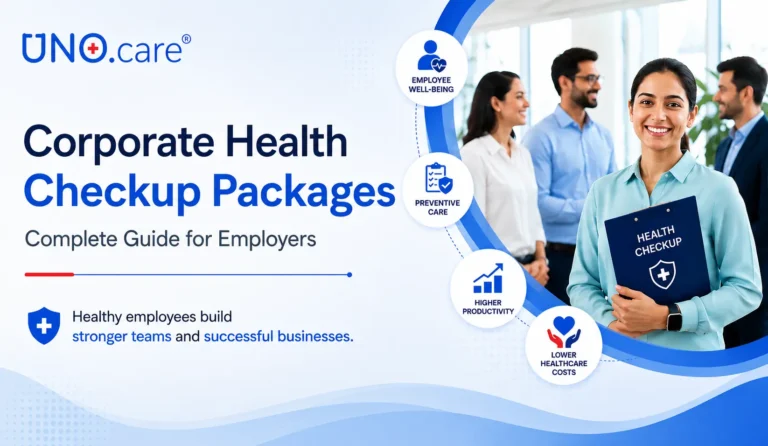
A Corporate Health Checkup is an employer-supported health screening program designed to give employees access to preventive health assessments. Depending on the workforce and purpose, it may include physical measurements, laboratory investigations, selected diagnostic tests and consultation with a healthcare professional.
Unlike an individual diagnostic test ordered to investigate a specific symptom, corporate screening is usually planned for a defined employee population. Its purpose may include preventive health awareness, periodic monitoring, occupational health requirements or broader employee wellness initiatives.
The exact scope should not automatically be identical for every organisation. A desk-based workforce, factory workforce, senior leadership team and field workforce can have different screening considerations.
Employee health screening is therefore most useful when the program reflects who is being screened and why.
Why Should Companies Offer Health Checkups to Employees?
Employee healthcare benefits are often evaluated by employees not only on what is offered, but also on how easy those benefits are to use.
Well-planned Corporate Health Checkup Packages can support several practical objectives.
They can give employees an opportunity to understand basic health parameters, discuss relevant findings with healthcare professionals and become more aware of preventive healthcare. They can also make screening more convenient by bringing services to the workplace or providing access through suitable diagnostic centres.
From an organisational perspective, such programs can complement employee wellness initiatives and create a more structured approach to workplace healthcare.
There is also an engagement aspect. A health benefit that employees can actually access, understand and complete is more meaningful than one that exists mainly as an HR policy.
Health screening, however, should not be treated as a substitute for individual medical care. Employees with symptoms, existing health conditions or specific concerns may require assessment beyond a standard workplace package.
What Should Corporate Health Checkup Packages Include?
There is no single list of tests that is medically appropriate for every employee. The contents of Corporate Health Checkup Packages for Employees should be selected according to factors such as age, sex, role, workplace environment, health risk profile and professional medical guidance.
Depending on the population being screened, a package may consider the following areas.
Basic Health Assessment
Basic measurements may include blood pressure, height, weight, BMI and other general clinical observations.
These provide useful baseline information but should not be mistaken for a complete health evaluation on their own.
Blood Investigations
Blood investigations may be selected to assess parameters such as blood counts, glucose or lipid levels where clinically appropriate.
The exact panel should depend on the purpose of the screening rather than on how many tests can be included in the package.
Metabolic Screening
Tests related to blood glucose and other metabolic indicators may be considered depending on employee age, risk factors and clinician recommendations.
Heart Health Assessment
Blood pressure measurements, lipid assessments, ECG or other cardiovascular investigations may form part of certain packages. More specialised tests should be selected only where relevant to the employee group or advised by healthcare professionals.
Liver and Kidney Parameters
Selected liver and kidney function investigations are commonly considered in broader preventive packages, although their relevance can vary between populations.
Vision and Role-Specific Assessments
Vision screening may be useful in certain employee groups. Occupational environments may require additional assessments related to job requirements or workplace exposures.
UNO Care, for example, states that its corporate programs can be configured around employee roles and workplace hazards rather than relying only on generic test lists.
Doctor Consultation
A report filled with numbers is far less useful when employees do not understand what those numbers mean.
Including access to an appropriate healthcare professional can help employees understand their results and determine whether further medical evaluation should be considered.
How to Choose a Corporate Health Checkup for Employees
This is where procurement decisions can go wrong. Comparing two Employee Health Checkup Packages only by price or number of tests gives HR an incomplete picture.
A better evaluation framework includes the following criteria:
- Understand the workforce profile. Review employee age groups, gender mix, work environment, location and occupational requirements.
- Evaluate test relevance. Ask why each major investigation is included. More tests do not automatically create a better package.
- Check for medical consultation. Determine how employees can understand important results or seek further guidance.
- Review reporting processes. Clarify how reports are delivered, how quickly employees receive them and what visibility the organisation receives without compromising individual privacy.
- Compare delivery models. Decide whether on-site camps, diagnostic centres, home collection or a combination makes operational sense.
- Check geographic scalability. Multi-location companies should know whether the provider can execute consistently across their workforce.
- Consider employee convenience. Complicated appointment processes and inconvenient timings can create avoidable participation barriers.
- Ask about data privacy. Health information is sensitive. Employers should understand what information is visible to HR, how individual records are protected and how consent and access are managed.
- Plan for follow-up. Screening should provide employees with a clear route to understand results that may need professional attention.
- Look for customisation. Packages should be capable of reflecting different employee groups rather than forcing every employee into one standard panel.
- Assess operational ownership. Clarify who coordinates scheduling, employee communication, vendors, camps, reporting and pending cases.
- Compare value, not simply cost. A cheaper package may become operationally expensive if HR must coordinate several laboratories, chase reports or manually consolidate records.
The strongest Employee Health Checkup Packages are therefore not necessarily the longest. They are the ones designed around the workforce being screened.
Corporate Health Checkup for Employees: On-Site or Diagnostic Centre?
Both models can work. The right choice depends on workforce structure.
On-Site Health Checkups
On-site camps can be particularly useful when many employees work at one facility, participation during shifts needs to be coordinated or travelling to diagnostic centres would create operational difficulty.
UNO Care currently offers on-site health camps alongside executive and pre-employment checkups and states that its teams can coordinate workplace-based screening and digital reporting.
The organisation still needs adequate space, scheduling, employee communication and appropriate medical infrastructure for the tests being conducted.
Centre-Based Health Checkups
Centre-based screening might be appropriate for employees who are located in different geographical locations or products that cannot realistically be brought on-site.
Additionally, UNO Care’s diagnostics service offers the ability to get tested through a network and provides chances for digital reporting and booking for employees. Having a hybrid model may work for many companies as opposed to utilizing the approach of selecting one of the two options.
How Often Should Employees Have an Annual Health Checkup?
The phrase Annual Health Checkup for Employees is common in corporate healthcare, but annual screening should not be interpreted as a universal medical rule requiring every person to undergo exactly the same tests every year.
In case of age, health condition, job exposure and risk profiles of the particular employee, the frequency of screening may vary. In some cases screening can be dictated by law.
It is therefore important for organizations to develop comprehensive annual programmes to meet the screening needs of their workforce.
Benefits of Employee Health Screening for Employees and Organisations
Benefits for Employees
Employee Health Screening can improve access to preventive healthcare by making basic assessments easier to complete.
Employees may gain:
- Greater awareness of selected health parameters
- Convenient access to screening
- A record of relevant health information
- An opportunity to discuss findings with healthcare professionals
- Greater engagement with preventive healthcare
Benefits for Organisations
For employers, a structured program can strengthen employee wellness initiatives, make healthcare benefits easier to administer and provide a more consistent employee experience.
It can also help HR teams move away from fragmented coordination involving separate laboratories, spreadsheets and manual follow-ups.
The value is often operational as much as medical. If employees cannot book appointments easily or HR cannot track completion, even a carefully designed package can underperform.
Common Mistakes Companies Make When Choosing Health Checkup Packages
One of the most common errors is assuming that the package with 80 tests must be better than one with 40.
Test count is a poor substitute for relevance.
Companies should also avoid selecting Corporate Health Checkup Packages without reviewing employee demographics, overlooking medical consultation, ignoring data privacy or failing to plan communication before the screening begins.
Another mistake is treating the health camp as a one-day activity.
Consider what happens afterward. Who receives the reports? Can employees understand them? What happens to pending screenings? Can HR see program completion without gaining unnecessary access to confidential medical details?
These questions often reveal more about a provider’s capabilities than the package brochure does.
How UNO Care Can Help With Corporate Health Checkups
UNO Care positions its corporate healthcare offering as an end-to-end employee health and wellness platform rather than simply a diagnostic booking service.
Its current health checkup offering includes executive health checkups, pre-employment screenings and on-site health camps. The platform also highlights role and hazard-specific package configuration, digital reporting and centralised visibility for organisations managing employee screening across locations.
UNO Care also provides diagnostics through NABL/NABH-associated laboratory services and supports digital report management.
For companies comparing Corporate Health Checkup Packages for Employees, this broader coordination layer matters. The objective is not simply to arrange tests. It is to create a manageable program covering package selection, employee access, execution, reporting and ongoing healthcare coordination.
Organisations can discuss workforce requirements with UNO Care and determine whether on-site screening, centre-based testing or a customised combination is more appropriate.
Choosing the Right Corporate Health Checkup Program
A Corporate Health Checkup should not become an annual exercise in selecting the largest test package at the lowest quoted price.
A stronger approach balances employee needs, preventive healthcare, convenience, medical relevance and organisational objectives.
Start by understanding the workforce. Select appropriate screening parameters. Decide how employees will access the program. Then evaluate whether the healthcare partner can coordinate execution, reporting and follow-up without creating another administrative burden for HR.
UNO Care offers corporate health checkup and employee healthcare solutions designed around different workforce and operational requirements. Organisations planning an Annual Health Checkup for Employees can speak with the UNO Care team to evaluate a program suited to their workforce.
Planning an employee health checkup program? Connect with UNO Care to discuss the screening approach, delivery model and package structure that best fit your organisation.