








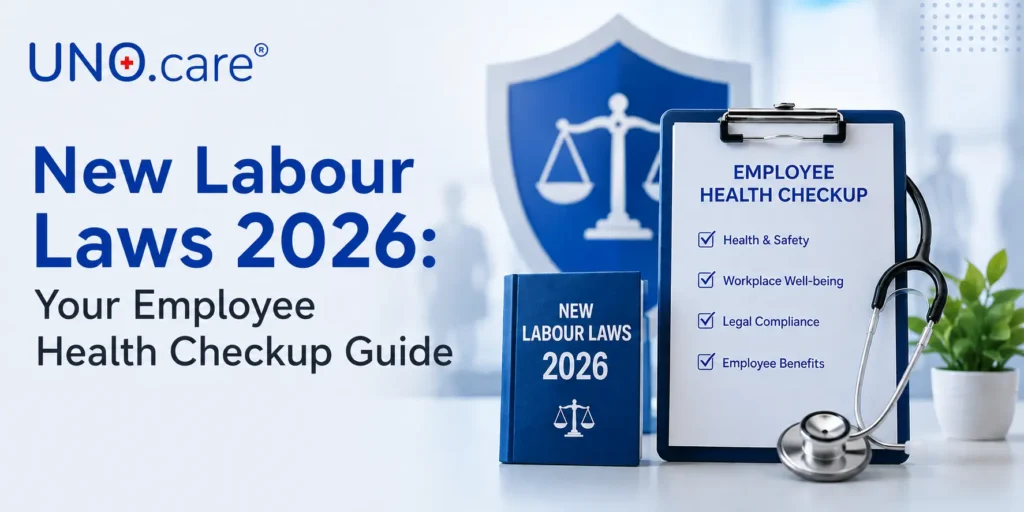
Employee health was previously an HR benefit that organisations were able to “play around” with, until 21 November 2025 when four labour codes came into force and made it the obligation of organisations. With the notification of final rules by the Centre, the blur started to become sharper on what the various codes actually mean. As a result of having finished finalising the codes (and their rules), if you have HR, are responsible for compliance or sign off on personnel decisions, the new labour laws as of 8 May 2026 are now “operational.” This guide offers a guide for you to sort out which employees are covered, and what organisations are actually required to do to provide health check-ups for employees, what an audit looks like, and how to get authoritative status before an inspector finds out about you.
What Are the New Labour Laws 2026?
Prior to the reforms, employers in India had to negotiate with respect to 29 different central labour laws, most of which were created in the 1930’s and 1940’s for a business world that no longer exists. The reform process has consolidated the existing 29 central labour laws into four modern labour codes including: the Code of Wages, Industrial Relations Code, Code of Social Security and the Occupational Safety, Health & Working Conditions (OSH) Code. When organisations are looking for health and safety compliance, they will focus on provisions contained in the OSH Code.
There are three significant dates to keep in mind when discussing the four Labour Codes.
- 21 November 2025 – The codes are effective from this date
- 30 December 2025 – Draft Central Rules were released and implemented by this date
- 8 May 2026 – The Central Rules became legally binding and measurable compliance with vague obligations became identifiable.
The Four Labour Codes at a Glance
- The Code on Wages 2019 – sets standards for minimum wages, timely payment, and the definition of ‘wages’ as a term which encompasses all forms of monetary payment an employee is entitled to receive.
- The Industrial Relations (IR) Code 2020 – contains provisions governing unions, standing orders, and dispute resolution processes.
- The Code on Social Security 2020 – provides an expanded safety net for workers including the previously unprotected profession of ‘gig workers’ and ‘platform workers’.
- The OSH Code 2020 – provides the framework for all workplace occupational health & safety, including health examinations, occupational health, and working conditions.
Why 2026 Is the Real Compliance Deadline
Where businesses often get confused is that while the Codes were notified in Nov 2025, the Codes do not inform employers what they are meant to do. The rules providing the specific details came into effect on 8 May 2026 for all establishments regulated by the Central Government (e.g., Banks, Telecoms, Mines, Railways, Ports, Central PSUs). Because the Labour Codes are on the Concurrent List, each individual State must notify its own Rules to be in compliance with the Codes. Many States are still mid-way through that process.
As a result of these timelines, the majority of businesses can expect that there is National Standardised Baseline for them to comply with and that the Compliance Machinery is being turned on; therefore, the excuse ‘we were waiting for clarity’ is not a defensible position anymore.
Is an Employee Annual Health Checkup Mandatory in 2026?
Yes, for some employers, it is unequivocally true. Conversely, it is the direction of trend and a significant risk if you do not adapt to it.
Here’s the precise version of what I just said: An auditor will look at your documents and determine whether you have complied with the OSH (Central) Rule 2026, which requires an employee aged 40 years or older employed in dock work, mining, and/or construction to have an annual physical examination at no cost to the employee by a medical professional who meets certain qualifications and to record the examination results on the form prescribed by the Central Government.
On February 12, 2026, Dr. Mansukh Mandaviya, Minister for Labour and Employment, stated in Parliament that annual health check-ups will be required for all workers who are 40 years of age or older under the 4 Labour Codes. The legislators are very clear about their intent; while only the Central Rule applies to a limited number of industries now, the various State Rules and the eventual Central Rule and/or amendment(s) to the Central Rule will close this gap.
A candid look into 2026; your business is required to have an annual compliance check up if you operate a high-risk (notified) business today. All other employers will struggle to make this a near-term requirement as new state legalizations of the statutory obligation will come into play, further reinforcing the responsibility to have the duty of care for your employees—no serious employer can overlook this.
Who Must Get a Free Annual Health Checkup?
Who Is Required To Get A Complementary (Free) Annual Health Check Up ?
Employees 40 years old or older and working in named, significant hazard sectors (dockwork, mining, construction)—now unquestionably covered by law as persons entitled to this service under the national regulations.
Workers (employed in hazardous or dangerous jobs)—sometimes require additional periodic (annual) workplace health surveillance (by National Workplace Health and Safety Regulations), regardless of age.
Employees 40 years old or older and working in other areas (e.g., IT, services, BFSI, or manufacturing) — All of these are not yet mean to receive this service under the national regulations; however, some companies will probably be seeking this service as an example of best practice and risk management. State/Country regulations in the areas where you are operating may already exist, requiring you to provide service to your employees.
Factory Act vs. OSH Code — What Actually Changed?
Previously, under the old Factory Act of 1948, the requirement for health checks would only apply to major companies (manufacturers of product); however, the Occupational Health Service Act creates a new framework for these health check requirements. The new framework makes compliance easier for small companies, by consolidating the responsibilities of the employer into a single requirement, and will require employers (with fewer than 20 employees and 40 employees, depending upon whether the use of electrical energy is used in the workplace) to register each workplace with the state or country. Additionally, the requirement to conduct safety inspections of construction sites is now limited to the “highly hazardous” jobs and this change will relieve some employer concerns; however, this does not give employers a free pass to disregard any workplace hazard by failing to provide the necessary periodic workplace health surveillance to employees.
Does the Law Apply to IT Companies and Startups?
By far , one of the most costly misinterpretations out there today. The OSH Code does not apply only to factories; it also applies generally to establishments (IT parks, warehouses, and service companies) under their welfare and registration provisions. The assertion that every two-person startup with a twenty year old founder must financially support their annual physical under the central regulation is not yet true. At this point in time, the universal requirement for all persons over 40 to be examined is limited to specific sectors. Smart employers in the high-tech and service industry will not sit back and wait for state regulations or a future central notification to make this requirement mandatory; they will begin developing there programs today, thus allowing themselves to take advantage of retention and branding benefits until such time as they may become compulsory.
OHC Compliance Requirements Under the OSH Regime
An OHC is an employer’s on site health monitoring, first aid and medical records provision. OHC obligations have always been affected by number of hazards and number of employees, and previously legislated through the Factories Act regarding hazardous material processing and large workplaces, but are now being maintained and standardised under the OSH system and provincial law.
When Is an OHC Legally Required?
There is no single, ideal number of employees needed for every employer with respect to occupational health centres; to suggest otherwise is a gross oversimplification. The number and requirements of OHCs are different depending on the type of industry sector, level of hazard associated with the workplace, and whether there are any regulations regarding the establishment from a higher authority.
Larger businesses that operate in hazardous industries should be prepared to operate an OHC (or something equivalent) on a permanent basis. Smaller, lower-hazard businesses can provide the intent of the regulation using a retainer agreement with a certified occupational health (OH) physician as well as with a diagnostic facility to which they would refer their employees for the required testing – they do not necessarily require a dedicated health clinic on-site at their place of business in order to comply with this regulation. The best example for significant compliance where businesses should begin to consider their heightened level of responsibility regarding their workers’ health and safety is the establishment of a safety committee as required by the Occupational Safety and Health (OSH) Administration – for example; establishments with more than 500 employees are required to have a safety committee.
What Must an OHC Include to Be Compliant?
Qualified Occupational Health Physician (either on-site or retained), as one of your OHC’s employees;
Adequate first-aid supplies and trained personnel present / on duty in ratios as required by applicable regulations;
Individual health records of each employee in the required format maintained at OHC;
Periodic health surveillance reports submitted to the appropriate regulatory authority.
The 2026 regulations are very much moving toward more digital healthcare records; therefore, the use of electronic health records will be acceptable and, frankly, preferred so they are more easily available, less likely to be lost, and provide a traceable audit trail for the regulators / compliance officers who will assist and/or monitor your compliance.
What Should the Annual Health Checkup Include?
Sector and state rules/culture will define what specific testing should be performed, but in general, the pragmatic answer is to create tiered packages by age; i.e., provide packages that meet well beyond any minimum qualifying levels. An acceptable core panel would include:
- Blood tests: CBC, fasting blood glucose, lipid profile
- Other tests: blood pressure, BMI, weight
- Kidney Function Test (KFT)/Liver Function Test (LFT)
- Vision screenings; audiometry for jobs involving noise exposure
- A doctor consult — and, just as importantly, having the results recorded and kept in permanent records from the consultation.
The justification for the business case is very strong. The most referenced research study in the space to date is the Harvard 2010 meta-analysis; the report found a return of approx. $3.27 for every dollar invested into employee wellness through reduced medical costs and approx. $2.73 for lost time-related costs as a result of absenteeism for a total return of approximately $6:1 return on investment combined. Although more recent research studies provide a more conservative approach and warn about caution regarding proven returns, all provide examples of proven returns involving well-designed chronic disease-based wellness programs measured across multiple years, but even with these assumptions, preventative health programs are one of the most sound lines on an HR budget.
Designing Age-Based Checkup Packages
Age 40 – 49: Core Metabolic and Cardiac Screening Panels
Age 50 – 59: Add Organ Function Tests, add Stress ECG/Exertional ECG, and add Cancer Screening Markers; i.e., PSA, Colorectal.
Age 60+: Comprehensive Panel Include; Bone Density Testing, and include Eye Exam/Ophthalmology.
The tiered structure is less costly and cleaner — you are spending your money where the risk lies, and you are walking into an audit with an explicit reason for spending money.
Penalties for Non-Compliance: What’s at Stake in 2026?
Skimming through this section typically results in regret for the employer. The OSH Code describes the penalties that will be applied to a violation, including escalation for repeated violations or willful breaches, as well as personal liability in the case of negligent harm to an employee. The 2026 rules also formalized digital documentation and reporting, meaning that if you have missing data or a paper-only record, it is not only cluttered, but is also a “red flag” that an inspector can act on.
Enforcement is moving toward a structured, trackable, and digital paper trail; a Compliance Record that is always readily available is a must-have for a clean audit versus a finding.
What a Compliance Audit Looks Like in 2026
A 2026 Compliance Audit will include reviews of employee age records and checkup completion logs (the percentage of eligible employees worked through the checkup process, not just that you have a vendor), your storage format for your records, any applicable OHC documentation, and proof of your diagnostic partner’s proper credentials. One of the most common ways otherwise well-intentioned employers fail is poor rate-of-completion on checkups; having the benefit on paper means nothing when half the eligible population has not utilized the benefit.
HR Compliance Checklist: Health Checkups Under the New Labour Laws
8-Step Checklist to Get Compliant This Quarter
- Pull the personnel list and filter to those at least 40 years old.
- Identify the hazardous/high risk roles (any age) with reference to both the OSH schedule and the state rules.
- Identify a NABL accredited diagnostic partner.
- Develop age based health checkup packages (40-49, 50-59, 60 years and older).
- Set up a digital dashboard to track the percentage completed for each of the packages.
- Create a system to audit compliant digital storage of employees including signed consent forms.
- Set up automated reminders to be sent to each employee at least 30 days prior to the due date of their annual checkup.
- Create or update your internal health checkup policy, making sure it refers specifically to the OSH framework.
Documentation HR Must Maintain for a Clean Audit
- The record of the employee health checkups, including the date, results, and physician signature
- Vendor accreditation documentation (NABL certificate of your laboratory vendor)
- Signed consent documents for employee health checkups
- OHC compliance documentation (if applicable)
- An internal health checkup policy that has been signed off by management
Digital records will be accepted and preferred by the auditors. Filing cabinets, when used for storage in a digital audit scenario, become a liability for an organization that maintains their employee records electronically.
Health Checkups for Remote and Hybrid Employees
The duty of care originates from the employment connection, rather than the worksite itself. For instance, if you have employees who are working remotely from an apartment in Bengaluru then that location does not exempt you from your obligations (ie., no badges into an office) to provide a safe and healthy place for your employees to work.
“Work from Home,” does not provide an exemption from compliance, and therefore should be seen as an opportunity to improve team accountability and productivity through effective completion tracking, not simply based on how many hours each individual is available at a certain time.
The easy way to accomplish this goal is to partner with an accredited laboratory that offers at-home sample collections; establish an employee booking process through your company’s existing methods of doing so; have results delivered electronically into your HR/OHC system; and maintain all documentation electronically. This is the same compliance as if you were having an employee shipped to your office, but significantly reduces time lost to travel for hybrid-first businesses.
2026 Trends Shaping Employee Health Compliance
- Digital is replacing paper. Paper records are becoming a thing of the past; commonly used platforms which contain all functionality needed to schedule appointments, send appointment reminders, store patient information and create audit ready reports are quickly becoming the norm, and 2026 regulations explicitly accept electronic records. Look for systems that can integrate with your HRMS.
- Mental health is entering the legal frame. The Occupational Safety and Health Code (OSH Code) has a much broader definition of “health” that includes people who are experiencing problems with their psychological well-being. Courts are beginning to define mental illness as a medical condition requiring treatment. Many proactive employers are incorporating mental health assessments into their employment practices, in preparation for meeting future obligations and/or retaining employees.
- Gig workers are in the net. Gig economy workers now have protections under the Code on Social Security that allow for the creation of a dedicated social security fund that will receive a contribution from aggregator businesses. Platform-reliant companies must check for their own compliance this year, not wait until next year.
- State variation is accelerating. As laws vary widely from state to state, the process of setting the central baseline has begun. Each state is setting its own rules at different rates and with different thresholds. Multi-state companies need to keep track of rules in each jurisdiction and obtain help from a labour-law professional when the landscape is disjointed.
Compliance Is the Floor, Not the Ceiling
Cynically regarded, the new labour laws for 2026 are a burden; strategically viewed, they are an opportunity and an imperative to finally develop an engaged, healthy, low-attrition, audit-proof workforce that employers have expressed interest in creating for many years. The risk of being penalized if your workforce is not compliant is real, but the reward — establishing a strong employer brand, reducing absenteeism, and having a compliant program that can successfully support your defence against inspectional activity — is much greater than the risk.
If you do three things this week, they should be the following: identify your workforce’s employees ages 40+, partner with a diagnostic organisation that has been approved by the NABL, and create an electronic audit trail of workforce-employee compliance. These three elements define the base of a compliant program — everything else you do will build upon that foundation.
With UNO.care you can build your infrastructure from the backbone up – through PAN India health checkups, Digital Pepsi Health Management Systems, AI built dashboards, and a single compliance report prepared for an audit all running off of one platform as opposed to 5 different vendors as separate solutions! Talk with our Compliance Experts today, or download our HR Health Checklist to be ready for your next audit!