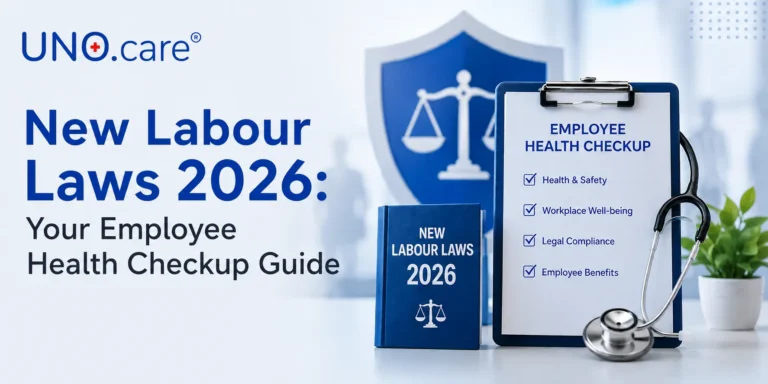














Most CHROs assess their organisation’s employee health programme as adequately managed — until a DISH audit finding, an ESG review requiring documented health data, or a statutory improvement notice produces evidence to the contrary. This 12-point checklist is designed to reveal the gaps that are invisible in normal operations but glaring under scrutiny.
The 12-Point Audit-Readiness Checklist
1. OHC Establishment and Staffing
Is a functioning OHC with a qualified medical officer present on every working day? Is there a documented backup coverage arrangement? Can you produce the OHC doctor’s registration certificate on request?
2. Pre-Employment Medical Records
Are pre-employment medicals conducted for all new joiners in roles that require them? Are records maintained in the correct statutory format? Are certifying surgeon requirements met for hazardous process roles?
3. Periodic Health Surveillance
Are annual health examinations conducted for all workers in hazardous roles? Are results entered in Form 7 within the required timeframe? Are follow-up actions documented for abnormal results?
4. Hazardous Substance Documentation
Is there a current register of all hazardous substances used? Is each substance matched to the health risks it poses and the health surveillance requirements it triggers? Have workers been formally informed in writing?
5. Noise and Dust Monitoring
Is noise monitoring conducted at required intervals in all relevant areas? Are audiometry records maintained for noise-exposed workers? Is dust monitoring current for all dust-generating processes?
6. Ambulance and Emergency Response
Is a statutory-compliant ambulance available on the premises or contractually guaranteed within the required response time? Is the ambulance crew trained and certified? Is the emergency response plan current and drilled?
7. Canteen and Rest Facilities
Do canteen and rest facilities meet the prescribed standards for worker capacity? Are inspection records maintained?
8. Welfare Officer Appointment
Is a welfare officer appointed as required under the Factories Act? Does the appointment meet qualifications requirements? Is the welfare officer’s register and activity log current?
9. Health Insurance
Are all eligible workers enrolled in the ESI scheme or an equivalent group health insurance? Are records of ESI contributions current?
10. Safety Committee
Is a joint safety committee constituted as required? Are meetings held at the prescribed frequency? Are minutes recorded and action items tracked?
11. Training and Awareness Records
Are records maintained of all health and safety training? Does training evidence cover induction for new workers, periodic refreshers, and hazard-specific training for high-risk roles?
12. Incident and Near-Miss Reporting
Is there an accessible channel for workers to report health concerns? Are statutory accident forms submitted to DISH within required timelines? Is the accident investigation process documented?
Turning Checklist Findings Into a Board-Level Roadmap
A CHRO who has completed the audit has a prioritised gap list. The next step is translating that into language that gets board attention and budget. The framing that consistently works with Indian boards is compliance liability quantification, not wellness philosophy. “We have documented Form 7 maintenance gaps representing an estimated ₹1.2 crore in statutory liability based on current penalty structures and our hazardous process headcount” generates budget consideration that “we need to strengthen our occupational health programme” does not.
Build a gap analysis matrix: each gap, its legal basis (which section of which Act), the maximum penalty exposure, the probability of detection in the next 12 months based on your state’s inspection frequency, and the cost to remediate. This becomes the board presentation — health investment with a clear risk-adjusted return, not a welfare cost.
Benchmarking Your Programme Against Peers
CHROs rarely have an objective view of where their programme stands relative to comparable companies. Useful data sources: DISH annual reports (public, state-by-state) which publish common violations by industry sector; industry association OHS surveys from CII, FICCI, ACMA; group health insurance claims benchmarks from your insurer showing whether your disease burden profile is better or worse than peers; and employee health survey data, which most companies collect but rarely compare systematically.
An occupational health programme that appears costly in isolation frequently demonstrates favourable cost-effectiveness when benchmarked against industry peers and measured against insurance claim ratios. CHROs who benchmark annually make better decisions about where to invest health programme budgets — and can show the board that their programme is ahead of or behind sector standards.
The CHRO Vendor Management Blind Spot
Most CHROs manage health vendors at arm’s length — reviewing annual reports and approving budgets. But execution quality is determined by operational oversight that most HR functions don’t provide. The documented result: annual health camp completion reported at 95% with no post-examination follow-up conducted; OHC coverage contractually “provided” with the medical officer absent 40 days per year; laboratory reports filed systematically but never reviewed by a qualified clinician.
The CHRO’s role in vendor management is to define outcomes, require data that proves they are achieved, and have an escalation path when they aren’t. Monthly OHC attendance data, checkup completion rates by department, follow-up rate for abnormal results — these are the metrics that tell you whether vendor performance matches the contract, not the annual review presentation.