



Factory health compliance encompasses more than just having a medical room and keeping track of employees’ visits. Businesses need to think about health check-ups, occupational health records, certificates that prove the workers are fit to perform their job, workplace accidents, referrals, the stock of medicines, and regulatory reporting across various working shifts.
When all these activities rely on paper, registers, spreadsheets, and different systems, important pieces of information can get lost. For example, there may be a delay with the medical check-up, or the fitness certificate may be unclaimed, while some accidents may be recorded at the Occupational Health Centre but not passed on to the EHS or HR departments that are responsible for it.
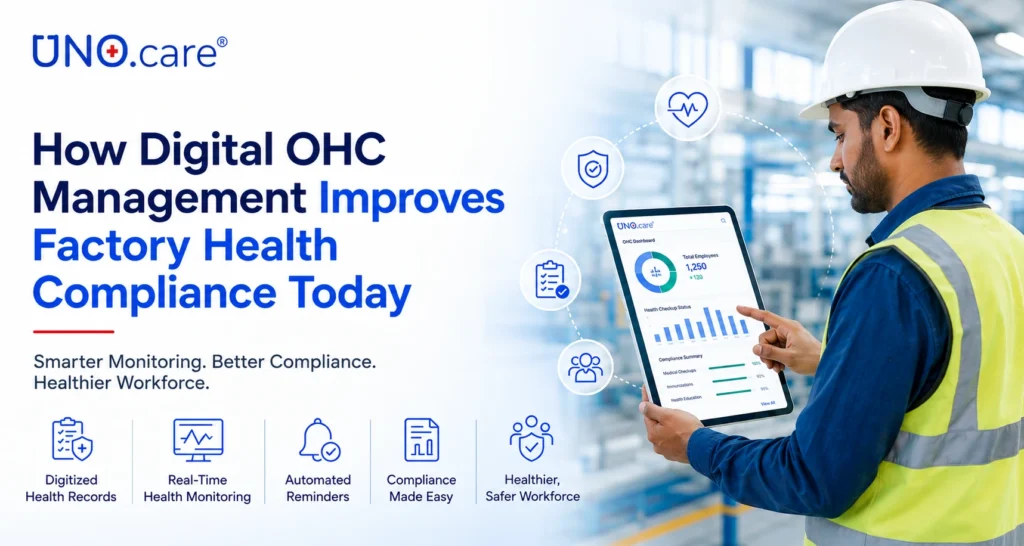
Digital management of the OHC makes it possible to integrate all these processes into a single system. It allows factories to standardize their occupational health processes, control their ongoing operations, monitor the tasks that are pending, and provide proper reports when it’s needed.
What Is Digital OHC Management?
Digital OHC management is the implementation of a centralized tool for handling day-to-day processes of an Occupational Health Centre.
Depending on the factory and the requirements, the following functionalities are provided:
- Employee and contractor health records
- Consultation records
- Pre-employment exams
- Regular medical check-ups
- Unfitness records
- Work-related injuries and first aid information
- Occupational exposure data
- Referrals and follow-ups
- Medicine stock
- Ambulance and emergency equipment
- Doctors’ and nurses’ schedules
- Compliance documentation and records
- Occupational health dashboards
It is worth noting that an efficient platform provides not just the storage of records, but also allows for linking medical activities with compliance requirements and deadlines.
Why Factory Health Compliance Becomes Difficult?
Factory medical compliance often entails several groups cooperating with each other. While doctors and nurses provide medical care, the EHS team assesses workplace hazards, human resources manages workers’ data, plant management oversees operation of the factory, and the compliance department ensures that all regulatory requirements are satisfied.
In the absence of an integrated system, each group may have its own records, which leads to a range of issues like:
- Indications of different data about employees in different records
- Manual scheduling of medical check-ups
- Storage of medical fitness certificates in paper files
- Mismatch of contractor registration data with entry data
- Recording of some accidents but no follow-up
- Fragmentation of health history across numerous locations
- Detecting problems with medicines only when a need arises
- Long time required for reporting
- Lack of a single perspective for management across factories
Such discrepancies do not necessarily mean that medical services provided in the factory are poor but indicate that the organization is incapable of providing proof of compliance with the corresponding requirements.
India’s Current Occupational Health Compliance Context
The Occupational Safety, Health and Working Conditions Code, 2020 was enacted on 21 November 2025. This regulation brought several central labour laws together under one umbrella of occupational safety and health legislation.
According to the Code, employers must provide their workers with a safe working environment without threatening employee health. Besides, it provides for free annual health checks for employees of a certain age, class, or establishment category defined by the government.
Moreover, the Code allows keeping the prescribed records in electronic or any other format and electronic filing of necessary returns. These changes contribute to the transition towards more digital compliance record-keeping.
Nevertheless, the specific occupational health requirements for the factory depend on:
- Applicable central and state regulations.
- Location of the factory.
- Manufacturing process.
- Hazardous substances being worked with.
- The number of workers and their category.
- Licence requirements.
- Government notifications.
- Advice of the Inspector-cum-Facilitator.
- Requirements for high-risk operations.
Forms, the schedule of medical examinations, record-keeping periods, or approval may differ. Thus, the digital system must be arranged based on factory requirements and not be generalized.
How Digital OHC Management Improves Compliance?
- Establishes a Consistent Health Record
This digital tool allows one to create an organized health profile for any employee with a verified ID.
This will allow medical professionals to find out about the employee’s injuries, medical history, and follow-ups in a single place.
This eliminates the need for duplicate records and simplifies deciding whether an employee needs any examination.
Moreover, a centralized system is important for maintaining continuous employee health records when an employee shifts their factory or department.
- Monitors Medical Checkups along with Timings
Factories may be required to do different examinations according to the age and position of the employee, together with the kind of exposure the employee experiences.
Manual scheduling may pose challenges because the number of employees could be in the hundreds or thousands and work in different shifts. Digital health care management can keep track of:
- Dates of checkups before employment
- Dates of compulsory checkups
- Health checkups depending on the age
- Checkups depending on exposure to unsafe factors
- Validity of health certificates
- Re-checkup dates of employees
- Return to work examination
- Follow-up health checks.
Such a system can remind OHC staff and responsible managers about upcoming health examinations.
- Links Health Surveillance to Workplace Exposure
Occupational health surveillance is more effective when health information is linked with the actual setting in which the employee is working. Digital systems can connect an employee with:
- The department
- Job position
- Technology
- Workspace
- Work shift
- Risk type
- Chemical or dust exposure
- Noise pollution
- Thermal exposure
- Ergonomics
- Personal protective equipment specifications
This link allows doctors and EHS to see what examinations/tests are recommended for the employee.
It enables authorized entities to do the analysis of aggregated trends per process/category/department without revealing the personal medical information of patients.
- Homogenizes OHC Management
Different production sites inside the same enterprise operate OHC differently. Some sites can keep a comprehensive account of consultations, while others only keep records of names of those being treated.
Digital management of occupational health centers standardizes practices and procedures across sites.
Each OHC can work with the same minimum set of operations at every location.
- Enhances Documentation of Injuries and Illnesses
After an accident at work, an employee may need to visit the Occupational Health Center (OHC). Various steps are usually required. The employee might require first-aid treatment, a referral for further examination, limited duty, or follow-up care.
Paper documentation creates uncertainties in terms of whether necessary steps were taken. Using a digital procedure enables:
- Time and date of an incident
- Employee and department details
- Type of injury or complaint
- Care given
- Referral details
- Work restrictions
- The follow-up date
- Fitness status
- Referral to EHS or upper management
- Closure status
This makes the records clearer as the case progresses from the first visit to the OHC to the result.
The system should not substitute for the factory’s formal investigation of an incident. It should connect medical information with the safety process while keeping hospital confidential information secure.
- Allows for Efficient Records Management During Inspections
Without quick access to records in compliance, they can be of low value.
Workplace health compliance software allows for the organization of records according to people, locations, date periods, processes, and compliance types, which gives persons entitled to do so a chance to generate reports ready for inspections without searching through lists, cupboards, or Excel files.
Depending on system settings, the reports may include:
- Completed and not completed health examinations
- Fit and unfit statuses
- Occupational health consultations
- Occupational injuries
- Referrals and trackings
- Medications taken
- OHC staff
- Prepared equipment
- Health monitoring
- Required forms and registries
Nonetheless, electronic records must correspond to the requirements existing for the types, verification, retention, accessibility, and realization of the materials needed by state institutions, since the requirements can demand certain signatures or approvals or material documents at times.
- Facilitates Compliance Monitoring Across Many Factories
HR, EHS, and OHC management often find it hard to compare compliance in various sites.
With the help of digital OHC technology, it becomes possible to create an online dashboard where the following information is displayed:
- Examination completion rates
- Overdue medical measures
- Pending fit-for-work decisions
- Open referrals
- OHC attendance statistics
- Injury case status
- Medication availability
- Equipment readiness
- Completeness of reports at the site level
This information enables management to find out compliance weak points before the audit or inspection.
This approach also helps management to make manufacturing facilities compliant and allows them to meet jurisdictional requirements and requirements related to the specific production process.
- Improves Medicine and Equipment Availability
Compliance for OHCs does not end with only keeping employee records. Occupational Health Centres should also look to maintain a stock of medication, first aid kits, relevant machinery, ambulances and emergency supplies.
One can track the following via an online platform:
- Amount of drugs in stock
- Minimum quantity
- Batch numbers
- Expiry date
- Consumption of medication
- Reordering processes
- Dates of machine maintenance
- Schedule of calibrating machines
- Ambulance checkup
- Readiness of emergency kit
Automated alerts regarding expiration of medications and stocks would help in avoiding any emergency shortages.
- Develop a Transparent Audit Trail
An efficient digital system keeps a log of the personnel responsible for the creation, assessment, endorsement, or modification of a record.
Audit trails include:
- Identification of the user
- Time and date
- What act was performed
- What was initially recorded
- What was changed
- Availability of the approval
- Why the modifications were made
Audit trails make electronic records reliable and help companies search for rectifiable or unauthorized changes.
Management records need not be simply overwritten. Any corrections should be traceable so as not to lose the data regarding compliance.
How a Digital OHC Workflow Operates
A workflow may be expressed by following the sequence shown below:
- Identification of worker: Workers or contractors are identified by either an identification number, QR code, or other methods currently available.
- Recording of OHC visit: The time, date, complaint, and type of visit are recorded.
- Evaluation by doctor or nurse: Doctor or nurse reviews and notes observations/medications/procedures and adjusts against the medical records.
- Medicines/referrals: Information about medicines issued, diagnostic variations, referrals, and other actions is recorded.
- Determination of employee’s status: If required, a certified person will note the status of the worker in accordance with the findings.
- Scheduling of the appointment: The system prepares the date and activity for the next step.
- Alerting of responsible team: Only the required information will be transmitted to HR/EHS/management.
- Closing of case: The file may remain open until all actions are completed.
- Reporting compliance: Any authorized user can prepare reports based on available information.
This workflow makes an OHC appointment effective because it does not let it stay as an isolated case without proper follow-up actions.
Features to Look for in Workplace Health Compliance Software
Factories must consider aspects other than the number of screens or reports provided by the provider.
Crucial features are:
- Customized Compliance Processes
The platform should accommodate specific state requirements, types of factories, medical examinations, and estimated forms.
- Role-Centered Access
Doctors, nurses, human resource departments, occupational safety teams, and factory managers should not be given unrestricted access to information.
Also, the medical information must be restricted to accredited doctors only, while the other departments should be given information needed for legal compliance or decision-making.
- Automated Advisories
The platform should have notifications concerning check-ups, expired documents, unfinished referrals, and lack of medications.
Each notification should have an owner and escalation process.
- Audit Technique
This system must include all important manipulations, approvals, or actions made by the user in its records.
- Multi-Location Administration
Corporate staff must look into compliance records of the factories without the need for the sites to have access to documents of other plants.
- Offline or Low Connectivity Functionality
Plants with internet connection issues need a procedure to register OHC work done during downtime and secure synchronization later.
- Integration Possibilities
The platform should allow connection with the systems of human resources, attendance, contractor management, laboratory, and hospital.
- Data portability
Manufacturers should always provide export files in accessible formats whenever needed for reporting, auditing, migration, or business continuity purposes.
- Security and privacy mechanisms
The system must guarantee secure authentication, encryption, access logs, data backup, retention policies, and authorizations for data exchanges.
Protecting Digital Occupational Health Records
The employee medical files contain sensitive information that needs to be protected accordingly.
The Digital Personal Data Protection Act of 2023 in India and the associated rules create the requirements regarding the lawful and responsible processing of digital personal data.
The digital occupational health center is supposed to support the following:
- The data collection has to be legitimate and lawful
- Only the data required for the specific purposes must be collected
- Access control based on roles
- Safe authentication mechanism
- Lost data trip report
- Logbook of data access and amendments
- Data retention plan
- Safe data deletion process
- Data correction procedures
- The privacy-enhancing technologies.
- Medical information shall not become a regular HR database.
In other cases, the manager must know that there are some temporary limitations for the employee. No need to know the information about the diagnosis or medications.
Steps for Implementing Digital OHC Management
- Identify Relevant Regulations
Determine all relevant laws, regulations, notifications, licenses, required forms, and internal policies relevant to each facility. Include regulations for particular hazardous manufacturing operations.
- Evaluate Current OHC Workflows
Document how workers are registered, examined, treated, referred, and followed up. Look for any redundant records, manual transfers, and unassigned responsibilities.
- Clean the Information on Employees and Contractors
Remove duplicates and standardize employee IDs, departments, workplaces, positions, and categories by exposure before launching.
- Establish Access and Privacy System
Establish the level of information that doctors, nurses, HR, EHS, and management personnel can receive.
- Build Compliance Calendar
Set up the frequency of examinations, alerts, escalation rules, and terms of the medical certificate validity period.
- Carry Out Pilot Testing in One Factory
Make a test rollout at one manufacturing facility before a large implementation.
- Provide Training to All User Groups
Train personnel in accordance with their duties and roles.
- Audit Digital Process
Ensure that all records are complete, alerts are delivered, reports meet regulations, and access is granted.
Metrics for Monitoring Digital OHC Performance
The indicators that can be monitored by the production plants include:
- The percentage of health assessments done on time
- Number of medical assessments done late
- Pending decisions on fitness
- Outstanding references and follow-ups
- Average time for references closure
- Completion of the Occupational health records
- Closure of occupational incidents
- Out-of-stock medicine cases
- Expired medicine cases
- Completion of equipment maintenance
- Time needed for compliance report production
- Percentage of users trained on the system
- Unauthorized attempts to access the facility
- Compliance blind spots by unit
These performance indicators should be used to make processes better.
Common Digital OHC Implementation Mistakes
- Digital Management of Scanned Paper
Uploading scanned paper documents does not result in usable workflows, notifications, or structured compliance data.
- Assuming Software Ensures Compliance
A platform can help with compliance. However, it does not substitute qualified medical personnel, correct processes, management accountability, or legal review.
- Using Generic Workflow for all Factories
Medical schedules and forms may vary by state, process, or risk category.
- Providing HR Unconditional Access
HR usually requires only information about persons’ fitness for work and restrictions but not all medical records.
- Creating Notifications Without Responsibility
Notification about overdue tasks may have little value if there is no person accountable for implementing it.
- Neglecting Contractor Medical Records
Contractors can perform the same dangerous activities as the permanent workforce, and therefore their examination results must also be accounted for.
- Not Planning for Downtime
OHC needs a secure way of keeping records about the activity when there are connection disruptions.
Build Better Factory Health Compliance With Digital OHC Management
Managing OHC through digital technologies offers factories a far easier way to manage occupational health documentation and procedures. It allows for replacing counterproductive spreadsheets with coherent workflows and notifications for needed actions and a thorough overview of health compliance.
However, the great value of digitization does not come from digital paper management but from the interlinking of every patient visit with the employee responsible for that.
It goes without saying that software alone does not provide factories with compliance. However, the right tool can make compliance management much simpler.